
[Note: This material serves as a supplement to my book manuscript, The Press in Transition: A Comparative Study of Nicaragua, South Africa, and Russia. An earlier version of this chapter appeared in 1998 in the Occasional Paper series of the Inter-University Consortium for Arab Studies, Montréal, and won the B.C. Political Science Association Essay Prize (Ph.D. Division), 1997.]
The press has total freedom; this is an undisputed issue because commitment to the freedom of the press, and providing it with a democratic atmosphere to express the causes of the homeland and the nation, stems from our commitment to the constitutional liberties and the government's desire to maintain this liberty so that the press may shoulder the responsibility of this stage - a stage that carries deep democratic changes in terms of the basic concepts of justice, tolerance, dialogue, acceptance of the other's view, and consolidation of the authority of the law.- Minister of Information Dr. Khalid al-Karaki, 1991(1)
For a time, the killing at police hands of Mahmoud Khalifeh was one of the great non-events in modern Jordanian history. Khalifeh, "an outspoken critic of Jordan's rulers," was gunned down, and his brother Bashar critically wounded, in a dawn raid on 2 June 1995. The assault, in a wealthy suburb of Amman, "sent a chill through a population not used to seeing dissidents dying in a blaze of gunfire. But officials never publicly acknowledged anything happened, local media ignored it and a detachment of police stood at the building for more than a week after the shooting." So wrote the Reuters journalist Jack Redden, in a story published on 2 July, analyzing an increasing wave of repression in Jordan after years of stop-and-start liberalization.(2) As Redden accurately noted, Jordan's "local media ignored" an event that was the talk of Amman for weeks after it happened. Redden avoided the fact that he himself did not risk publishing a story on the events for a full month after they occurred.
Finally, on 17 August, the news broke through the surface of the Jordanian press. (It never stood much chance of being carried by Jordan's broadcast media, a regime monopoly.) Sa'eda Kilani, a feature writer for the Jordan Times, Amman's liberal English-language daily, reported intense debate in Parliament over "the case of the Khalifeh brothers." The Interior Minister, Salameh Hammad, finally had deigned to comment in writing on the matter, claiming the brothers had been shot by police "in self-defence." Kilani, though, reported opposition parliamentarians' forceful criticisms of the police action. An Islamist parliamentary deputy, Bassam Emoush, was quoted as demanding the Minister reveal "who issued the order to shoot [Khalifeh], what was he accused of, and whether the police operation could have been carried out differently." According to Dr. Emoush, Mahmoud Khalifeh's "problem was that he was a man of principle. He wanted to speak his mind and say what was right and what was wrong regardless of who was involved. ... Is it reasonable," Dr. Emoush demanded, "that such barbaric action be taken against him?"(3)
The press treatment of the Khalifeh affair speaks directly and indirectly to many of the main themes that have engaged the Jordanian press since 1989. On the one hand, it confirms some of the more pessimistic analyses of the depth and substance of the Jordanian liberalization process. The liberalization era has not seen a radical transformation of the regulatory environment in which the country's media operate. The Press and Publications Law (PPL) of 1993 replaced pre-liberalization legislation, but retained many of its more sweeping constraints. This included a ban on reporting of material that might cast aspersion on Jordan's armed and security forces. The ban extended to foreign correspondents based in Amman, as the Reuters correspondent covering the Khalifeh affair well knew.
The continuities in ownership, control, and regime restriction of the press explain the Jordanian media's own reluctance to discuss the events of 2 June 1995 until the issue was raised for the record in parliament and thereby "legitimized." Parliamentary discussion, in turn, may have been possible only after the Minister of Information chose to rescue the event from the memory hole by acknowledging it in writing. There is much evidence here of the continuing de facto marginalization of both parliament and the press as arenas of national debate in Jordan.
In the interregnum between the Khalifeh events and the first coverage of them in the Jordanian press, George Hawatmeh, editor-in-chief of the Jordan Times, was asked why the paper - which has a limited but deserved reputation in Jordan for bold commentary and investigative reporting - was holding off on the story. "Nobody told us not to publish" the Khalifeh story, Hawatmeh responded. "But you needed a statement, at least, by official sources as to what happened. How could you tackle such a sensitive story from only one side, or on the basis of what you hear on the street or what's said in the tabloids?"
What of the view that this gave the regime inordinate power? Hawatmeh was asked. Did censorship remain if a story could be killed simply by the regime's refusal to comment? "According to the Press and Publications Law, if you say anything that might be conceived as against the security forces, you could be jailed for up to two years," Hawatmeh replied. "I can take a chance, but I'd be liable to prosecution. And the story in its own right was so sensitive that it could have created problems much bigger than me, bigger than any newspaper." Hawatmeh was speaking from recent experience. At the time of the interview, he was appealing the first-ever conviction of a mainstream daily under the new Press and Publications legislation. His transgression: publishing material that reflected poorly on the Jordanian security services.
As Redden's original article on the Khalifeh killing makes plain, the events - and the media (non-)response to them - took place against a larger political backdrop. The peace treaty with Israel, signed in October 1994, precipitated a sharp downturn in regime tolerance of dissent and opposition. The situation was such that, despite numerous eloquently-expressed criticisms of the 1993 PPL, most journalists and editors canvassed on the subject in Summer 1995 were convinced that amendments to the legislation could only work to their detriment - given the stresses that had riven the Jordanian body politic since the signing of the peace agreement. Their concern proved justified. The post-peace crackdown in Jordan - of which the Khalifeh killing was only the most sanguinary evidence - testified to the partial, "mushy" nature of the Jordanian liberalization since 1989. As Glenn Robinson has argued, the process since the Ma'an riots of that year can be characterized as "defensive democratization" - "a series of pre-emptive measures designed to maintain elite privilege in Jordan in the face of demands for more significant reform." Many more substantial political transitions have begun as limited liberalizations and then spun out of the regime's control, a process Robinson calls "democratic snowballing."(4) But "democratization in Jordan," as the Times' George Hawatmeh has written, "was not a revolution."(5) And at the time of writing, it shows no sign of becoming one, or even of sparking a more thoroughgoing transition.
Liberalization is liberalization, however. In its way, the Khalifeh affair attested to this as well. George Hawatmeh was able to publish brief word of the events in the small-circulation, London-based Middle East International as early as 9 June, with no known repercussions.(6) Within a couple of months of the killing, the Minister of Information felt called upon (or at least able) to give the government side of the story. This opened the matter to parliamentary debate - recall Dr. Emoush's denunciation of the regime's "barbaric" actions. The Jordan Times and other papers then could provide a fairly complete rendering of events, carefully including both sides of the story, but raising questions and criticisms of real substance.
Any evaluation of the Jordanian liberalization must acknowledge that it is taking place under a regime generally considered one of the "softest" in the Arab World. The monarchical/tribal system of rule has long secured for Jordan relative freedom from the vicious state abuses that are common elsewhere in the region. It has also spawned a more tolerant and pluralistic political climate, one that has shaped mass media among many other state and societal institutions. The degree of press freedom in King Hussein's Jordan has been attained only rarely elsewhere in the region over the last three decades - in places like Kuwait, Lebanon (before the civil war), and Algeria (in the brief period between liberalization in 1988 and the descent into civil war; today the country is probably the least congenial environment for journalists anywhere in the world). More common in the Arab World is the Syrian or Iraqi model: totalitarian control of the media and savage repression of debate and dissent, so intensive that "journalists ... are an extinct species."(7) The middle band of the spectrum is dominated by environments like those of Egypt, where the major newspapers "are headed by strong pro-regime figures" but a limited opposition press exists, or the Gulf, where "investigative reports are almost non-existent ... and government-appointed officials directly or indirectly supervise most newspapers," though without serious brutality.(8) The emergent nation-state of Palestine, meanwhile, has disappointed observers who found Yasir 'Arafat's ringing promises of democracy and press freedom hard to reconcile with the punishment his regime meted out to wayward journalists and publications.(9)
Today, even in the chilly and unstable post-peace environment, Freedom House's 1994 assessment - that "for all its shortcomings, the Jordanian press ... is the most level-headed and reliable in the Arab World" - would need very little revision.(10) The media environment in Jordan also remains a good deal more diverse than before the liberalization process began, in the print if not the broadcasting spheres. The rise of the tabloid and political-party press in Jordan is the most visible (and interesting) evidence of this new diversity, and is considered in detail later in the chapter.
The Jordanian Media System:
Broad Outlines
It is natural that the existing press are supportive of the government; they are owned by the government.
- Fu'ad al-Khalafat, Islamist parliamentarian, 1992(11)
The journalistic culture here is part of the dominating culture in the country.
- Lamis Andoni(12)
Jordan displays essential features of an authoritarian media system. All broadcast media are owned by the state and controlled by the government of the day.(13) Strict control over Jordan Radio and Television is exercised through the government's Ministry of Information, which also oversees print media, and can act against any perceived dissonance between press behaviour and press legislation. The Royal Court communicates its preferences directly to managers of the broadcast media, and to a lesser extent the daily press. There is a large state news service, Petra.(14)
Although cited statistics vary, it is certain that at the time of writing [February 1999] the government, directly and through the "social corporations" it controls, owns a majority of shares in the Jordan Press Foundation, which publishes Al-Ra'i, Jordan's largest daily paper (along with the English-language Jordan Times). The government owns at least a substantial minority or a slight majority of shares, but anyway a controlling interest, in Al-Dustur. This paper is the remaining daily competition for Al-Ra'i, in the wake of the early-1995 demise of Sawt Al-Sha'b - in which the government also controlled a large majority of shares.(15) Nabil al-Sharif, Chief Editor of Al-Dustur, called government ownership "the first and most important" constraint on press functioning in Jordan:
It is not a direct hindrance or obstacle, but it definitely affects the overall atmosphere of freedom that we would like to have. ... When you say that the government owns 65 percent of the shares [in Al-Ra'i], and the government has nine out of 12 members of the Board [of Directors], what does that mean? It means the government appoints the General Director [General Manager]; it appoints the Chief Editor; it has some sort of invisible influence over the editor. The government doesn't have to say, "Do this, do that," once you feel that your whole position is in the hands of the government. ... The mere fact that the threat is there, that you are somehow in the hands of the government, definitely affects the freedom of the press. It creates a psychological barrier.
A further element of majority control is the ability of the "regime" - in Jordan, a triumvirate of government, monarchy and "establishment" forces - to subsidize newspaper operations by siphoning state and government advertising revenue to the establishment dailies, especially Al-Ra'i. "All other daily and weekly newspapers are excluded from government advertising," Article 19 reports of the Jordan case. "Most newspapers have no revenue other than the meagre income from sales" - but are banned by government legislation from seeking funding or support abroad.(16) Thus do the favoured, mainstream few become the exclusive recipients of regime largesse. Thus, too, does the regime continue to dominate the mainstream of public discourse. The increased financial health of the favoured newspapers, moreover, rebounds to the material benefit of the regime, in the form of higher dividends on government-held shares.(17)
In Jordan prior to the Ma'an riots of 1989, the high degree of government ownership was matched by an authoritarian tradition of punitive legislation and direct regime oversight. The punishment was particularly severe after martial law was reimposed in 1967; regime oversight extended far beyond the openly-monopolized broadcast media. A 1987 report on conditions in Jordan stated that "the Ministry of Information daily reviews the newspapers and meets with editors, providing guidelines and instructions on how to approach certain topics, and which topics should simply be omitted altogether." The Press and Publications Law of 1973 allowed the government to "close any paper without reason, and without right to appeal." All journalists had to be licensed by the Jordan Press Association - and therefore vetted by the Mukhabarat (Interior Ministry), which "must approve all applications, and uses the process to sift membership and also to promote collaborators and informants."(18)
For Nabil al-Sharif, speaking in 1995, the growth of an entire generation of Jordanian journalists was stunted by the authoritarian tradition. "We have only lived and breathed the air of democracy for four years [since martial law was lifted on 7 July 1991]. Most of the journalists working in newspapers now have been under martial law for close to 20 years. If you work for so long under martial law, you are likely to begin to believe that everything the government says is right; everything the opposition says is wrong. You're conditioned to think that way. It takes a lot of time to recondition yourself, to reprogram yourself."(19) Authoritarianism also imbues a society with a particular ideology of information control. The expression of professional imperatives, as defined earlier, is rendered substantially more difficult when sources - government ministries and officials, archivists, the person on the street - are wary of speaking. "You've got to understand that this whole new process of openness has yet to put down roots in the country and the mentality of the people," argued Ayman al-Safadi, editorial page editor and senior political writer at Jordan Times. "You'll find a lot of people reluctant to talk. If they do give information to you, most of the time it's on an off-the-record basis, which weakens the validity of your reports. Verifying information is very hard as well. You have to nourish your own sources, make sure they develop confidence in you and trust your professional abilities and ethics."(20)
Authoritarianism in Jordan is bolstered by a tradition that runs even deeper in the political culture than the Hashemite monarchy. Nabil al-Sharif called it "the tribal factor." While he was careful to stress that "tribalism has many positive aspects," his account emphasized how day-to-day professional operations and judgments were liable to be overwhelmed by "social considerations":
The tribe acts as one entity. If a criminal commits a crime, and he comes from a certain tribe, and if you write the name of the person with the name of his tribe, the whole tribe becomes angry. "Why did you defame the name of our tribe?" Here, the law of the tribe is supreme. What about a corrupt official, a minister for instance, who happens to be from a certain tribe? If you write about him negatively, in many cases it's his tribe that will object. "What do you have against our son?" they'll say. [So you start to think:] "Well, maybe I shouldn't publish that last name. Maybe I shouldn't publish the story at all." Or you'll write it up as: "It was rumoured that a certain person was found doing this and that ..." You end up with a story that is lacklustre, that doesn't really mean anything. It could be a front-page story that deserves great prominence, but you can't publish it. Not for political or legal reasons; not because of the government; but for social considerations.(21)
Tribalism's patriarchal character exerts a further influence and constraint on Jordanian press functioning. Journalism is overwhelmingly a male profession in Jordan,(22) with one notable exception - the liberal Jordan Times, where the reporting staff was around two-thirds female in 1995.
The Jordanian liberalization can be divided into four stages. In the first, from the "austerity"-inspired riots of April 1989 to the Iraqi invasion of Kuwait in August 1990, one of the more authoritarian governments in modern Jordanian history - led by Prime Minister Zaid Rifa'i - was transformed by a process of limited democratization that saw the lifting of martial law, a revitalized parliamentary life, and regime vows to "modernize" Jordan by broadening political participation.(23) The powerful monarch acknowledged mistakes and the need for change. Islamic fundamentalists moved to the forefront of a newly feisty political arena, scoring "results exceeding those predicted even by optimist[ic] supporters of the movement" in the landmark parliamentary elections of November 1989.(24)
The second stage began in Jordan, as in the rest of the region, on the morning of 2 August 1990. Iraq's invasion of Kuwait thrust Jordan into its most severe political and economic crisis since the Six-Day War. Jordan's Islamic fundamentalists, buoyed by their election success, led the opposition to western intervention in the Gulf; but that opposition resounded through all levels of Jordanian society. Patriotic feelings ran high; elite actors in politics and society formed a National Front to manage the crisis.
The Iraqi defeat in the ground war of February-March 1991 inaugurated a third stage in the Jordanian liberalization. It was characterized by a cresting of Islamist influence and the beginnings of a reaction against that influence, by both the regime and the wider society. The end-result of the "backlash" was a refashioning of electoral procedures for the 1993 parliamentary voting. The old electoral system may have favoured the Brotherhood: it was, after all, "the most influential and best organized of all political groups in the country."(25) The new one-person, one-vote system was generally held to favour traditional and tribal candidates, while redrawn electoral boundaries gave added prominence to constituencies where such candidates dominated.(26) Stage Three also saw the zenith (to this point) of liberalization in Jordan, and its growing institutionalization. The quasi-constitutional National Charter in 1991 was signed by prominent Jordanians across a broad spectrum of national life,(27) and in September 1992 the ban on political parties was lifted. Internationally, this period was marked by Jordan's profound isolation from traditional allies and supporters, as the country struggled to re-establish its credibility with powerful actors regionally and globally.
The fourth and most recent stage began with the second post-liberalization elections to parliament, in November 1993, and ended with King Hussein's death in February 1999 after a long battle with cancer. During this stage, the new parliament set the seal on resurgent tribalist influence and renewed regime assertiveness vis-à-vis dissident opinion. The restabilizing of the status quo was accompanied by a growing string of diplomatic "successes" (at least as most western opinion perceives them), climaxing with the signing of a peace treaty between Jordan and Israel in September 1994. The peace treaty's impact at the domestic level, however, was highly ambiguous. It provoked a groundswell of popular anger and resentment, prompting in turn a wave of limited repression by the regime. The atmosphere in Amman in Summer 1995 was one of "chill" and democratic rollback, though the regime remained liberal by regional standards.
This breakdown of the liberalization process may assist us in exploring key patterns of change versus continuity in the Jordanian press, and in press-regime relations, during the 1990s. For this analysis, though, a benchmark is needed: the state of Jordanian media at the time of the outbreak of the Ma'an riots of April 1989. The rioting and other unrest that greeted the Rifa'i government's attempts to impose IMF austerity measures in Jordan helped to end "a dismal period in the history of journalism in Jordan," in the words of one Jordan Times editorial.(28) King Hussein himself had begun the adverse trend in 1985 with an open letter accusing "a number of our newspaper writers" of "launching attacks on our social institutions and their customs and values."(29) Measures against the foreign press followed in May 1988. In August of the same year, the Rifa'i government announced its startling decision to take over formal administrative and editorial control of the press institutions that it materially controlled. On less than an hour's notice, entire boards of directors and key chief editors were fired and replaced, or resigned in disgust. Among those dismissed was Mahmoud al-Kayed, chief editor of Al-Ra'i. Rami Khouri, editor of the Jordan Times, resigned shortly after: he "could not accept to edit a paper under conditions which saw government employees come in late at night and check our editorials" (see the Jordan Times case-study).
Lamis Andoni notes that in the months following this night of the long knives, "at least three journalists were fired for publicly opposing the new information policies as the margin of free expression in the local press was almost eliminated."(30) Early in 1989, the government-run Social Insurance Institution, the most prominent of the "social corporations," bought up the bulk of the private shares still held in Al-Ra'i and Al-Dustur, "thus completing the effective nationalization of the daily press."(31) During the following, brief period of direct government control,
any information emanating from the Ministry of Information was expected to be treated as, in the words of an official, 'gospel' and be carried with no elaboration or explanation of the issue involved. Local editors recall dozens of occasions when they were told to use "only the Petra version" of the story. ... The ministry used to hold regular meetings to instruct the local press about what was permissible for publication and what was not[ , ] and had watchdogs at all the three papers ...(32)
The initial transformations in this arena under liberalization were delayed, but dramatic when they did come. The new government of Zayd Ibn Shakir lifted much of the day-to-day vigilance over the press. A formal return to the status quo ante, though, had to wait until the first post-liberalization elections produced a less authoritarian government under Mudar Badran. Shortly after Badran took power in December 1989, old boards of directors were resurrected at the newspapers, and former editors returned, for the most part, to their posts. The press spent much of the next few months exploring how far their new leash extended:
Issues related to the liberalization policy, such as the limits on free expression and the legalization of political parties, began to be discussed, often critically, in the press. The papers began to air public grievances on a wide range of issues, such as the rising cost of living, unemployment, and the level of public services. The government and the press were also more open and informative on the gravity of Jordan's economic difficulties.
Still, Susser notes that even at this early stage, the basic character of the press's role in the transition was being established. "The freedom granted ... did not signify a radical departure from Jordan's authoritarian tradition. It was the regime that granted this freedom and determined its parameters. Journalists remained cautious and uneasy as they groped to define the bounds of their newly acquired freedom."(33) In this respect, the press resembled other key actors in the Jordanian liberalization, such as the Muslim Brotherhood (and other Islamist groups), professional associations such as doctors and engineers, and certain Palestinian cultural organizations. Like those institutions, too, the press's newfound independence was all but surrendered when the Gulf crisis descended on the region, the appeals for national unity rang out, and the second stage of Jordan's liberalization began.
When a society falls into step, most journalists are too responsive to the stirrings of the crowd and too susceptible to martial music to do anything but grab a drum and join the parade. At these times government controls seem almost superfluous.
- Mitchell Stephens(34)
The Iraqi invasion of Kuwait was greeted with an almost universal outpouring of enthusiasm in Jordan. The reaction was perhaps less vocal the further one moved up the social ladder; but even among elites, ambivalence towards the Iraqi actions was expressed only in the most mainstream press coverage, and in those closest to the ruling circle. To the outside observer, Saddam Hussein's pledges to redistribute Arab wealth from the greedy Gulf to the impoverished periphery may have seemed cynical and improbable. But the Jordanian masses - like most poor Arabs from Yemen to Morocco - seized on Saddam's promises like manna. Even for more privileged Jordanians, the sense of historical redress was inescapable. "There was what I would call a sense of injustice," said Jordan Times Political Editor P.V. Vivekanand, "coupled with the frustration over seeing the affluence of the Gulf countries. It was a question of, 'The Kuwaitis did not help us when we needed help, and now they deserve what they're getting.'" Five years after the Iraqi invasion, Jordanian editors and journalists sometimes drifted into nostalgia, recalling the unifying effect the Iraqi invasion had on a frustrated and long-humiliated citizenry. "The morality of the Iraqi invasion was never an issue" for the press, Vivekanand argued,
because nobody said Iraq should not have invaded Kuwait. I would say the overwhelming majority of the people I talked to here - 98, 99 percent of the people, at all levels [of society] from the top to the bottom - they were saying that, yes, Kuwait deserved it. I seriously can't recollect anybody who said that what Saddam Hussein did was wrong. That was the thinking on the street. And the media reflected it.
The formal expression of this crisis, and the brief unity it brought about, came by the end of August. Jordanian political forces across the spectrum - including long-banned Communists, Islamists, and Arab nationalists - formed a National Front aimed at opposing western intervention in the Gulf and supporting a negotiated solution to the conflict. The formation of the Front solidified the democratic groundswell of the year before, when negotiations had commenced towards constructing a National Charter to reconfigure regime-society relations in Jordan. The consensus the crisis created in turn spurred the Charter process, which would conclude only a few months after the guns fell silent in southern Iraq, and which stands in retrospect as the highwater mark of the Jordanian liberalization thus far.
With regime and society tending towards cautious concern at best (e.g., King Hussein), and more often towards excitement and euphoria (the Palestinian population and many others), it is little wonder that the most critical perspective the Jordanian press could muster at the news of the Iraqi invasion was to call it a possible "complication" (Al-Ra'i), or a source of "regret" and "pain," nevertheless excusable (Al-Dustur).(35) The Jordan Times, the most "westernized" of Jordan's dailies, pressed for non-intervention in the days following the invasion. At times, it expressed editorial sympathy for Saddam's plight that would have done the Baghdad Post proud. "President Saddam is not a new Hitler, nor is he a loose tiger," the paper editorialized. "He is an Arab patriot whose higher ideal is the service of the Arab peoples and their interests. ... All Arabs would come to Iraq's help if attacked by the U.S., Israel or any other foreign power. Those Arabs who will acquiesce in such aggression will be doomed."(36)
During this stage of the Jordanian liberalization process, the Islamist bloc in Jordan seems to have shared Saddam's immunity to press criticism. A rigorous content analysis would be necessary to establish this claim more fully. But it is noteworthy that the Jordan Times, a paper that had demonstrated a marked lack of sympathy for the Islamist agenda and would again after Spring 1991, refrained entirely from publishing critical commentary or editorials for the duration of the crisis and war. The onset of the Gulf crisis also may have nipped in the bud a line of investigation that was new to Jordanian civil society: corruption. The scandal of Jordan's 1988-89 economic crisis had accounted for a good deal of the public anger that eventually spilled over in Ma'an and elsewhere. The events spawned a series of parliamentary investigations of key officials, including former Prime Minister Rifa'i; in 1992, a campaign spearheaded by the maverick Islamist deputy Layth Shubaylat would come within a single vote of the super-majority necessary to impeach Rifa'i on corruption charges. But for the most part, the press had followed in the Islamist wake during the initial post-liberalization phase. Only sporadically did it surge ahead with its own investigations of the corruption issue - a "docile" stance that might, in retrospect, be seen as one of the key missed opportunities of the post-1989 liberalization process.(37) In any case, in the climate of national crisis and unity in 1991, carping about corruption was bad form. Said Vivekanand: "Before the whole thing could really mushroom into something that would have taken a sweep at basic pillars of the society, the Iraqi invasion ... shifted [the issue] to the back burner."
If support for the Iraqi invasion was almost universal in Jordan, so too was the sense of disillusion after the crushing Iraqi defeat at Allied hands. "The end of the Gulf war is indeed a day of reckoning and soul-searching for all Arabs, governments and peoples alike," the Jordan Times proclaimed soberly on 3 March, once the extent of the rout was plain.(38)
In the wake of the Gulf conflict, a number of commentators sought to address the deficiencies in press performance during the crisis. Few were as blunt in their criticisms as journalist Khalil Mahmoud, who accused the press of "deceiv[ing] citizens and insult[ing] people's intelligence" in its coverage of the war.(39) Rather, much of the self-evaluation had an apologetic but still somehow self-exculpatory tone, evident too in the reflections of interview subjects in 1995. The most common stratagem to explain press behaviour, or explain it away, was the claim that the popular groundswell had irresistibly shaped press coverage. In one of the first public post-mortems, for example, Walid Sa'di said the press had merely served as "a faithful mirror of the people's sentiments":
[Although] there were some faint voices within Jordan which whispered opposing views, ... such views were kept muted by choice of those who held them. I doubt that the Jordanian press would have refused to print an opposing views [sic] had the people who expressed them in private chose[n] to do so in public. As the current of support for Iraq was so overwhelming, it was unthinkable for the silent opposer to swim against the current and say loudly what they were thinking and saying quietly.(40)
One can only wonder to what extent this argument was employed because it allowed journalists and editors to present a professional failing as evidence of increased democratization. If the press had proved incapable of providing the public with a reasoned appraisal of events, it at least stood by the public and captured its sentiments. George Hawatmeh made this slightly dubious leap when he argued that the "sizeable freedoms" enjoyed by Jordanian newspapers meant that "their editorial policies have been moulded more by their own - and readers' - thinking and ideas than by the government in power. This is how their position on the Gulf conflict evolved." Less regularly acknowledged was the fact that, if popular pressure did not suffice, there was always the government of the day's own clearly-stated objective to 'mould' the papers' editorial lines, and public opinion, further. "If there were any hesitation on the part of the people and the mass media," wrote Sa'di, "it was resolved firmly in the direction of the signals that emanated from the government."(41)
Examining "the skirmishes over the press" in Jordan since 1989, Glenn Robinson has argued that they "seem to be located entirely among Jordan's elite":
Indeed, there is no obvious grassroots movement for a free press. Within this elite there are clear differences of opinion as to what role the press should play during the liberalization period. However, there is consensus both inside and outside the press that the media should not play an antagonistic role vis-à-vis the government or the dominant power relations in Jordan. It appears that muckraking is not one of the jobs of Jordan's press.(42)
This analysis tells us much about the performance of the mainstream press in Jordan over the last few years. It overlooks, however, one of the most striking features of the Jordanian liberalization: the flowering (some would say rash) of tabloid and political-party journalism in Jordan, as de jure restrictions on the parties, and de facto restrictions on the tabloids, were relaxed after 1989. I refer to this as the "rise of the popular press." It is a common phenomenon in liberalization and transition situations, as we will see further in Chapter 6.
The party press. The rapid growth, from 1993, of political-party publications like Al-Mustaqbal (of the Future Party), Al-Jamahir (Jordanian Communist Party), and Al-Watan (Progress and Justice Party) proved a shaky, possibly transitory affair. Their blooming was quickly followed by a winnowing. The limited resources of peripheral political sponsors could not prevent material challenges from overwhelming publications like Al-Ba'th (paper of the Jordanian Arab Masses Party), Nida' Al-Watan (Jordanian Democratic Popular Unity Party), Al-'Asr Al-Jadid (the Democratic Arab Islamic Movement Party-Du'a'). All were formally licensed in late 1992 or early 1993, along with their party sponsors; all had ceased publication by early 1995.(43) The new wave of regime suppression detailed in the postscript could prove the final nail in the coffin.
The party press exists to advance the political agendas of its sponsors. Party publications are mobilizing media in the purest sense, "popular" in that they are oriented towards the masses, but espousing no professional ethic beyond a conviction that the sponsor best represents the interests of the citizenry as a whole. They are critically dependent on party resources. In other countries, party affiliation might be an advantage in strict survival terms (it is otherwise hard to explain the endurance of a downsized Pravda in Russia, for example). In a poor country like Jordan, though, parties are fledglings, marginalized from the real centres of power. Party resources are correspondingly shaky, and the party press is vulnerable and often short-lived. All of these challenges must be confronted before the issue of regime tolerance can even be addressed; but the regime, too, is capable of delivering a death-blow to even a flourishing party publication. On balance, while the party press can be seen as an offshoot of the liberalization process in Jordan, it has played only a marginal role in that process - except to serve as a useful scapegoat when the regime is in a reactionary mood.
The tabloids. The rise of independent tabloid papers like Shihan and Al-Bilad is a different and more intriguing development. As we saw in the Nicaragua case-study, tabloid journalism (or "yellow journalism") tends to be pitched at the lowest common denominator of public taste and functional literacy. Its content emphasizes aspects of experience that are both common and sensational - so that neither the popular interest nor the supply of easily-obtainable stories is likely to wane. In exploring its favoured topics - sex, violence, and scandal - the tabloid tone is often sensationalistic. Not surprisingly, this approach to journalism is viewed with derision in many mainstream quarters. Mohammad Amin, the Ministry of Information's chief overseer of press functioning and editorial content in Jordan, accused the tabloids in 1995 of "dragging the community to a low standard of language":
Our [Jordanian] community is a very conservative community. It is an Islamic community. At the same time, it is an open community. It is a moderate community. In general, we are not fanatics. But we have our limits. The values of the West are not our own values. In some respects we have a difference of point of view, or heritage, or religion. So these tabloids are pushing more than a little too far. You know, they are publishing sex exposés, things like that.(44)
Of the three editors-in-chief of Amman's mainstream dailies, one - Suleiman Qudah of Al-Ra'i, who also serves as President of the Jordan Press Association and the International Organization of Journalists (IOJ) - was openly dismissive of the tabloids. In his view, they had had a "bad effect on the press itself, on journalism, and on the Association." Another, Nabil al-Sharif of Al-Dustur, acknowledged that the tabloids published "a few stories here and there that were quite good and daring," but strongly criticized their slapdash approach to fact-checking - "we're not talking about a responsible press." Only George Hawatmeh of the Jordan Times viewed the balance-sheet as a positive one for Jordanian journalism:
I personally think that the tabloids have had a positive impact, if only because they can energize situations and people. They are daring. They have courage in exposing or talking about issues that the pro-establishment, the daily newspapers, basically don't tread on. They're not perfect. They have investigative reporting, but it's not well-documented, it's not well-researched. But the fact that they're tackling what were taboo issues for a long time is a positive thing. There is much more variety in the Jordanian press today. I think any river that flows enriches the soil around it. Weeds also grow, but you can't stop the river.
For a view from the tabloid trenches, one can turn to Jehad Momani. In 1995, Momani was chief editor of the largest and most influential tabloid, Shihan, which first began publishing in tabloid format in 1984.(45) According to Momani, though, only when he began to transform Shihan after the onset of liberalization did the paper become the popular fixture that it is in Jordan today. Momani's restructuring concentrated Shihan's coverage on three main themes: politics, sex, and crime. Politically, he said, Shihan considered itself "a principled opposition organ," bounded by respect for the King, who was "above the law." Momani said this opposition orientation had proved "very good from a commercial point of view," in a country where all the daily newspapers were "not trustworthy." "The people," he stated firmly, "like us when we oppose the government, when we tell them where is corruption, where mistakes are being made." Momani thus cast himself straightforwardly as an exponent of the western "watchdog" model for the press, and in conversation he made clear his preference for western models of social modernization as a whole. Consider his reflections on Shihan's troubled relationship with the Islamist opposition, the force in Jordan most vocally concerned with western cultural influence:
Our problem is, we [in Jordan] talk too much about the past. We are too close to the Arabs of two thousand years ago. The right thing to do is forget the past. ... We have to talk about fashion, about rock music. But there are some people in our country who don't want us to forget the past. ... We want [the Islamists] to be as they choose to be - Muslims, praying - but don't lead me. I want my country to be a part of Europe. I want to be a part of civilization!
Shihan's greatest coup came with its unveiling of "Malhasgate." The scandal centred on accusations made by the outgoing Health Minister, Abdul Rahim Malhas, in an interview with Shihan in early 1994, to the effect that much food and medicine imported to Jordan was "the garbage of the industrialized world" and unfit for human consumption. Malhas subsequently claimed Shihan "blew [his remarks] out of proportion" and "sensationalized" them, but they sparked urgent talks in the Lower House of Parliament, and a spate of coverage in the mainstream press.(46) "People call us 'the brave one,'" Momani said proudly. "We always open things up." Notably, he viewed Shihan as playing a vanguard role vis-à-vis Jordan's mainstream dailies. "In the beginning, [the dailies] think [a certain story] is untouchable. Then, after we publish something on it, they think: If the government didn't punish Shihan, then maybe we can talk about it." It is hard to know how much of this evaluation is self-serving, but the idea of the tabloids as violators of taboos in the Jordanian press seemed to be accepted by most parties - though it was as often decried as praised.
Momani acknowledged that Shihan's investigative journalists sometimes made professional mistakes, "but not big mistakes. Mistakes in the details. We say that the Minister of such-and-such stole one million dinars. The question is not whether the Minister is innocent or not. He is a thief. But maybe he just stole one hundred thousand [dinars]." Most of the errors, he claimed, were traceable to the culture of secrecy that surrounds information in Jordan, and the added reluctance of official sources to divulge material to Shihan in particular. "Shihan journalists all the time face problems with officials and ministers, corporations or companies. They know that when Shihan talks, it means there is a big story. So they try to keep their secrets. And they try to set traps for us, so we'll make mistakes."
So much for politics; what of the sex-and-crime corners of the triad that guided Shihan's self-conception (and that of several other tabloids) under Momani? In late 1994 and early 1995, three tabloids - Shihan, Al-Bilad, and Hawadeth Al-Sa'ah - came under "heavy attack ... for publishing photographs of semi-naked women and sensational stories."(47) In fact, the "semi-naked women" were clad; their photos had been doctored to give an illusion of translucency to their form-fitting garb.(48) The reaction was typical, according to Momani:
When we talk about sex, people [here] can't understand it, because Jordan is an Arabic, Islamic country. We're not talking about sex like you talk in Canada! We're just talking around the subject. ... We believe that we have to talk about sex, about crime, about our social problems. ... In the future, we'll talk about sex like we talk about fruit and vegetables. Because it's something very important to our lives. We are talking about sensitive problems about ten or fifteen years before anyone else. ... You'll see, they'll start a war against us: the other newspapers, the Muslim Brotherhood. 'What are you doing? You published a nearly-naked woman in your newspaper! But we are Muslims!' But it goes in one ear and out the other with us.
Again, it must be stressed that the degree of indulgence granted Shihan in sexual matters did not approach the salaciousness of western tabloid reporting. This restraint scarcely obtained, though, when crime was the subject. In March 1994, the sexually assaulted and decapitated body of an eight-year-old child, Lo'ai Araiqat, was discovered in Zarqa, Jordan's second city. Shihan published pictures of the victim's body; scattered over the pages of various editions were headlines, allegedly quoting the suspect in the case: "'I am a monster and I don't deserve to live,'" "'For God's sake allow me to kill myself, I wish all people would spit on me,'" "'I have sex five times a day,'" and so on. Ziad Rifai, head of the Yarmouk University Communications Department, described the coverage as "cheap and revolting."(49) And the tabloids' sensationalistic treatment of crime drove Jordanian authorities to distraction. "Sometimes people [in the Gulf states] tell me, 'We're not coming to visit Jordan this summer, we're going somewhere else,'" said Nayef Mawla, Deputy General of the Ministry of Information. "I say, 'Why?' They say, 'You don't read the newspapers?'"
The regime's grey hairs notwithstanding, Momani seemed firmly convinced that such coverage bolsters Shihan's relationship with its readers - the primary bond for a publication that enjoyed neither the approval of the regime nor the enthusiastic support of state and corporate advertisers. "A woman called me two days ago and told me, 'Shihan has become a very dangerous habit in my life! Thursday morning, I send my daughter to bring it to me; if she can't find it in the supermarket, I get mad. It's like breakfast for me!'" The degree of popular devotion allowed Shihan to evade the early, often decisive pressure of advertisers' boycott of popular-oriented publications.(50)
There existed the possibility of a more 'professional' journalism emerging from the tabloid scene. In July 1995, one of the veterans of the tabloid press, Nidal Mansour (who wrote for Shihan and edited Al-Bilad, and was briefly jailed by the authorities for stories published in the latter), moved to found a new weekly, Al-Hadath. Mainstream critics like Suleiman Qudah credited Al-Hadath with moving away from the standard formula of Jordanian weeklies - de-emphasizing sensationalism, and working to promote critical, independent journalism in Jordan.(51) In conversation, Mansour also rejected aspects of his tabloid heritage, saying Al-Hadath sought to avoid "exaggerating in our presentation of subject matter ... We are cautious not to arouse excitement over unimportant subjects."
Patterns of press-regime relations in post-liberalization Jordan coalesced around the redrafting of Press and Publications legislation that dated back to the era of martial law. The reconfiguring was typical of those the regime negotiated with other social actors and forces. Restrictions were loosened, and some regime powers were abandoned or put out to graze. But the essential subordination of ruled to rulers was also codified and entrenched. In the process, a truly transitional spiralling of the liberalization process was successfully avoided.
The Press and Publications Law (PPL), approved by both houses of parliament in December 1992 and March 1993, was a schizoid document. Introduced by the government, ostensibly as a contribution to the democratization process, it underwent extensive modification at the hands of parliamentarians, to the obvious detriment of press freedom and autonomy.(52) Many representatives held the press in contempt: from Islamists who felt excluded and marginalized by the secular mainstream media,(53) to pillars of the establishment displaying their hereditary sensitivity to criticism. (While parliament often seemed a marginal player in the course of post-1989 Jordanian politics, its contributions to the 1993 press legislation served as a reminder that it could exert an important influence on the parameters of liberalization. Unfortunately, it chose to exercise that influence in a manner that targeted the press, rather than working to shore it up as a fellow "estate.")
The PPL as eventually passed began by declaring that "freedom of expression is guaranteed for every Jordanian." It committed the government (and "government institutions") to a reduction in their direct or direct ownership of press organs to a maximum of 30 percent of shares by 1997. The central advantage that the press won under the new legislation was a repealing of the government's right to close any press institution at will. A temporary suspension of the institution's activities could be imposed, but any further action had to take the form of government prosecution through the court system. The courts, as a result of their own post-1989 transformation, now stood at a certain remove from the regime - far enough away to overrule regime initiatives on occasion, though not in the face of the recent "chill" in press-regime relations (see the postscript).
But if these moves could be seen to boost press autonomy, a sterner orientation was also evident. The first indication came with the PPL's definition of a journalist as "every person who meets the conditions stipulated in the valid Press Association law or who takes journalism as his [or her] profession and is registered with the Association." The PPL thus entrenched the role of the Jordan Press Association as a pro-regime "gatekeeper," one charged with pressuring or marginalizing unruly elements within the press (see below). It also included an extensive list of direct constraints on press functioning and coverage. Journalists were allowed "to keep secret the sources of their information" - until, that is, a court "decide[d] otherwise in the process of a criminal case to protect state security, prevent a crime, or to serve justice" (Article 5D). Publications were to "refrain from publishing what conflicts with the principles of freedom, national responsibility, [and] human rights; [and] shall respect the truth and the values of the Arab and Islamic nation" (Article 8). Designated editors-in-chief, now exclusively Jordanian citizens, were legally "responsible for what [was] published" in their publication; "The owner of the publication and the writer of the published article also share[d] [legal] responsibility" (Article 14. In fact, joint or multiple prosecutions under the PPL have been the norm rather than the exception). Article 20 gave the Minister of Information power to license all publications, and to deny licenses if sufficient financial backing could not be raised (a minimum of JD 50,000 registered capital for a daily newspaper, for instance; no small hurdle in a poor country like Jordan, particularly when foreign contributions are banned. In 1997 this regulation was made much more stringent still, as will be discussed in its place).(54)
By far the most controversial section of the Law was Article 40. It forbade publication of:
1. News that touches on the king and the royal family.
2. Any information on the number in the Armed Forces, their arms and ammunition, or their movements unless the publication of such news is authorized by a responsible authority in the Armed Forces; as well as any news report, sketch, or commentary that touches on the Armed Forces or the security agencies.
3. Articles and items degrading any of the religions or sects whose freedom is guaranteed by [the] Constitution.
4. Articles which may harm national unity, inspire crimes, or spread hatred and sow the seeds of rancor, disunity, or discord among the members of society.
5. The proceedings of the parliament's closed sessions.
6. Articles or news reports aiming at shaking confidence in the national currency.
7. Articles or information which include a personal insult to heads of Arab, Islamic, or friendly states ...
8. Articles or news reports that infringe on the honor of individuals or their personal freedom, or tarnish their reputation.
9. News reports, letters, or pictures that violate ethics and public decency. ...
10. Foreign publications that contain any of the materials prohibited by this law will be denied entry.(55)
Predictably, when the draft Press and Publications legislation was unveiled before parliament, it generated an unprecedented wave of opposition among Jordan's journalistic community. As early as 23 August 1992, about 40 journalists staged a public demonstration against the draft legislation and Lower House amendments to it.(56) Ayman al-Safadi wrote in the Jordan Times that the country's "incompetent, dull, imperceptive, and teethless press" was about to be further hidebound by a law that was "a giant step backwards" and "a complete disappointment":
Its restrictions are crippling, its language is elastic, its definitions are vague; it leaves the government with too much power, the press with too many concerns. ... The media will thus continue to be confined to being a mouthpiece for the government, reporting the news that it wants to pass to it. ... By any serious standard, the draft law makes a mockery of freedom of expression in Jordan.(57)
In an editorial, the Times called the endorsement of the Law by the Lower House "a black day for the press," one that "will go down in Jordanian journalists' record books as the day on which their cause and that of the freedom of expression took a heavy blow. ... For the blunder that the House has committed, it deserves no thanks."(58)
The international response, though more muted, was equally critical. Article 19 warned that the draft PPL "contains many provisions which ... would undoubtedly put freedom of expression and information in jeopardy." The article forcing journalists to reveal their sources if ordered to do so by a court, for example, would "virtually muzzle all officials in possession of information of public interest."(59) Glenn Robinson's observation that "virtually any news worth printing would contravene" one PPL provision or another may have been overstated.(60) But it emphasized the discretion the regime had in keeping the press off-guard through selective, unpredictable "strikes" under one or another proviso of the PPL. The uncertainty lent increased prominence to self-censorship in reportorial and editorial decision-making: a traditionally low-cost, non-invasive, and functional replacement for direct regime oversight. In this sense, Jordanian journalists still had grounds to empathize with the Palestinian writer who said of the pre-1989 intellectual climate in the country: "I really feel as if a policeman sits on my chest and as if there is a scissor in my brain." The Palestinian's counterpart in post-liberalization Jordan could feel that the policeman was at least off drinking tea, rather than an all-pervasive presence. But if the scissors in the brain had grown a little dull, later events would demonstrate they could still cut.
Actual instances in which the PPL has been used to bring wayward press organs into line, and cases where its use has been overtly or indirectly threatened, are the most useful evidence of the legislation's intended role in shaping press-regime relations. It is also worth considering how the PPL is subsumed in the regime's broader conception of the role of the press, the parliamentary opposition, and ordinary Jordanian citizens.
How has press legislation been applied since 1989, both under residual martial law legislation and under the new PPL of 1993? How does legislation fit into the broader pattern of press-regime relations, and what other mechanisms does the regime have at its disposal to discipline wayward press institutions? Regime strategies can be divided into three general categories, with resort to formal charges under the PPL or the penal code playing a greater or lesser role in given instances:(61)
Preservation of the inviolability of the armed forces and security forces.
In Jordan - as is examined in some detail below - the monarchy is immune, and the government is the designated lightning-rod and whipping-boy. This leaves the army and security forces atop the list of regime institutions that neither enjoy the unconditional respect of press and public, nor tolerate the type of scorn sometimes heaped on the government of the day. Article 40.2 of the PPL was designed not just to preserve security around matters such as troop deployments and dispositions. Indeed, this intention may not even have been primary. At least as significant was the desire to draw a veil over the limited abuses of human rights that the Jordan security forces inflicted, for the most part in the campaign against radical Islamist opponents and other, more peripheral dissident elements.
Sensitivity to trespass on the "rights" of the army and security forces underpinned several of the most important regime actions against the Jordanian press since 1989. The pattern of harassment and prosecution began with Al-Ribat's publication in September 1991 of a report by the Public Liberties Committee of the Jordanian House of Representatives. The report had been issued about two weeks before its publication in the Muslim Brotherhood weekly. It summarized investigations by an opposition-dominated parliamentary committee into "detentions, restraint of liberties, treatment of detainees, interference in appointments, clubs, and societies, reinstatement of employees dismissed on political grounds, and political prisoners."(62)
The Ministry of the Interior issued a pointed statement rejecting the allegations, and "regretting the publication of material in newspapers before consideration of an opposite viewpoint and verification of facts."(63) No direct prosecution was launched against Al-Ribat for publishing the text of the report - an indication, perhaps, that the regime still had not come to a consensus on the appropriate limits of press freedom and parliamentary opposition in the new circumstances. But the publishing of the report apparently precipitated regime harassment of Al-Ribat that was as serious and systematic as any visited upon a Jordanian press institution in the first half of the 1990s. The unwanted attention included numerous bannings and confiscations of individual editions of the paper. These are described in greater detail in the next section, since the later bannings were not security-related.(64)
The next time the regime was confronted with a potentially incendiary security matter, it chose a pre-emptive strategy. This effectively quashed inconvenient publicity and commentary. Two Islamist deputies, Layth Shubaylat and Ya'qub Qirsh, were put on trial in September 1992 for illegal possession of weapons and links to terrorists abroad. The generally-held opinion, in Jordan and internationally, was that the prosecutions were politically motivated at best, trumped up at worst. Certain Jordanian press outlets - particularly the tabloids - made "speculations" along these lines, at least in the eyes of the Minister of Information. Their editors' attention was then drawn "to a 1959 criminal proceedings law which states that newspaper editors could be imprisoned for publishing information which could influence judges, witnesses or court staff entrusted with investigation."(65) The gag order limited journalists to reporting only testimony approved for release by the Security Court judge. It largely served its purpose, allowing the regime to proceed through the show-trial conviction of Shubaylat and Qirsh and their sentencing to 20 years' imprisonment with hard labour, all a prelude to a magnanimous pardoning by King Hussein. (Shubaylat would be rearrested in 1996: see the postscript.)
The most severe early demonstration of the regime's security sensitivities occurred in September 1993, during the trial of ten Islamists accused of plotting a coup against the government. Ramadan al-Rawashidah, a journalist with the Jordan People's Democratic Party's weekly Al-Ahali, published an article on 20 September charging that the State Security Court had delayed granting doctors access to prisoners. The article reported defence claims that the prisoners had been tortured. Al-Rawashidah further alleged that he had been banned from the courtroom; he demonstrated outside the court with a sign protesting the "injustice" of his exclusion. On 26 September he was arrested outside the courthouse and held for "slandering the court."(66)
The regime action prompted a demonstration in front of the Ministry of Information by some two dozen Jordanian journalists "express[ing] solidarity with and protest[ing] against their colleague's detention."(67) Al-Rawashidah was held for five days, then released on bail - and in through the revolving door went Jamil al-Nimri, editor of Al-Ahali. He was charged with contempt of court for publishing al-Rawashidah's story. The Jordan Times called the prosecutions "an unprecedented measure ... since the democratisation process was launched in Jordan in 1989." But the tale took a twist that swept up the Times itself: it became "the first independent mainstream newspaper to go on trial" for violating the PPL.
The prosecution was a delayed result of Times reports following in Al-Ahali's footsteps and expanding on the weekly's coverage of torture allegations. An article by Sani Atiyeh, published on 11 October 1993, cited graphic defence testimony, including one defendant's claims that an "officer had stripped him and threatened to shove a stick in his rectum if he did not sign a testimony that tied him to the plot to kill the King."(68) Immediately after the article appeared, Atiyeh and Times Editor-in-Chief George Hawatmeh were called in for security-branch questioning. Formal proceedings were temporarily shelved, then reinstated; Atiyeh and Hawatmeh went on trial in April 1994, followed shortly thereafter by al-Rawashadeh and al-Nimri of Al-Ahali. (The charges against the Al-Ahali duo were thus considerably more serious than the charges laid against Jordan Times. The Al-Ahali staff faced up to two years in prison - an interesting act of regime discrimination, to which we will return.) On 16 May, Atiyeh and Hawatmeh were convicted and ordered to pay a fine plus costs. They immediately appealed the decision, but it was upheld by the court of appeals in June 1995, immediately after al-Rawashadeh and al-Nimri had been found guilty and fined (not, as it transpired, jailed).(69) In conversation in 1995, Hawatmeh angrily derided the "outrageous" proceedings:
It's a basic test of the freedom of the press. If you're quoting a defendant in the newspaper, and you get prosecuted for it - I mean, that's the limit of undemocratic practice as far as, say, a country like the United States [is concerned]. ... So the fact that they've taken us to court over that particular thing is outrageous. And it's outrageous that we were convicted in the first court, and in the Appeals Court. If the Supreme Court says we were right to be convicted, it's a catastrophe!
Nonetheless, Hawatmeh argued that the court system, particularly the Supreme Court, exercised "a lot of independence" in handling the appeal:
We've seen two cases where even those who were accused of plotting to kill the King were freed. So in theory, the independence is there. Especially with the big guys at the Supreme Court. It's not one little judge at the first-instance court, who's afraid to absolve you of such a charge, generally, because he has ambitions within the system, because he doesn't want to take the responsibility to interpret the law on his own. ... We're hopeful.
Detention and prosecution appeared appear to be distinct regime strategies, and were rarely employed in combination. Prosecution under the PPL, one of the less severe actions, has with only one exception targetted "popular" rather than mainstream press institutions. More severe regime actions, like criminal prosecution, detention, and confiscation are likewise the exclusive lot of déclassé tabloid and political-party media. Mainstream media have largely immunized themselves through their own caution, self-censorship, and often institutional clout within the regime itself. This evaluation would appear to hold as of early 1999, with the disparity in treatment cast into even sharper relief by the regime's mid-1997 crackdown on the press.
Preservation of good relations with "friendly" states. Jordan's foreign-policy priorities explained a number of prosecutions and other regime actions against the press during the liberalization era. In these instances, the targets were less commonly the tabloids and more often the Islamic weeklies and political-party newspapers. These sometimes had a partisan political interest in slinging mud at foreign figures; with Jordan urgently seeking to resurrect itself in the eyes of regional powers and potential aid-givers, the regime's skin proved decidedly thin. The most heavily-targeted publication was Al-Ribat, the Muslim Brotherhood weekly. Beginning in late 1991 - shortly after Al-Ribat had revealed the details of security abuses in Jordan, as described, and concurrent with the regime's post-Gulf crackdown on the Islamists - four editions of the weekly were banned and confiscated by the authorities. A February 1992 banning was apparently the result of vociferous criticisms - slander, according to the Minister of Information - of 'Yasir 'Arafat and Saudi Arabia's King Fahd. Kamal Rashid, editor of Al-Ribat, commented at the time: "In a nutshell, they [the censors] don't want us to talk about the Arab countries with which Jordan wants to improve relations, nor to write about our rejection of the peace settlement of the Middle East crisis."(70)
In November 1992, another edition of Al-Ribat was banned and confiscated "because it contained an article about repression and torture conducted by the Tunisian authorities against Islamists," at least according to a statement by Al-Ribat's management.(71) The harassment campaign heated up again in 1995, as the dimensions of the opposition to the 1994 peace treaty with Israel became plain, and the regime chose increasingly to suppress rather than tolerate them. An edition of the Islamic weekly Al-Muharrir was confiscated in January 1995, after the paper published an interview with Libya's Mohamar Qadafi in which Qadafi expressed strong criticisms of Arab states that had signed peace treaties with Israel.(72) Barely two months later, in March 1995, the regime breached the boundaries of the absurd, charging the weekly Al-Majd under the PPL for
publishing a riddle that is considered offensive to the president of the United Arab Emirates, Sheikh Zayed Ben Sultan Al Nahayn. The riddle ... asked readers to identify an imaginary animal "with one eye, one ear, lives in the wilderness, eats honey and stings like a bee. The creater [sic] is homosexual, hates women and is shortsighted." ... [Al-Majd] said the riddle seems to be written by Sheikh Zayed but "distributed by his enemies." The weekly readers should send answers to the royal palace in the UAE capital, Abu Dhabi, to qualify for a prize of one million UAE dirhams.(73)
Once again, the regime demonstrated considerable selectivity in targetting the popular press as opposed to its mainstream counterparts. Al-Ribat's editor protested the preferential treatment at the time of the weekly's February 1992 banning. Rashid was quoted as "saying that other newspapers - published inside and outside Jordan - had been writing more critical articles about the same issues and that they were neither banned nor censored."(74) Some support for his argument could be found in the pages of the Jordan Times, a generally-favoured institution that has exploited regime benevolence in order to report on human rights abuses around the Arab World - even, tentatively, in Jordan. A scathing editorial of 17 December 1992, on the occasion of an Arab Writers' plenum in Amman, lamented the dismal state of the intellectual establishment through the Arab World. It pointed a finger at state repression as "the main culprit":
It is not a secret that Arab regimes are the main culprits behind the stifling of the freedoms of thought and expression that in turn resulted in a culture fearful of being invaded and defeated from the outside. Perhaps other writers, not so distinguished or guilty by association with repressive regimes, would identify the real problem and point their fingers to it.(75)
If this seems too abstract in its condemnation, consider the editorial of 29 May 1993, which charges several Arab countries by name with gross abuses:
The quest for freedom, democracy and full human rights in the Arab World has begun and people are on the march to realise what is their birth right. No matter how brutal, backward or entrenched the regimes are, people will triumph. ... Authorities in countries like Tunisia, Egypt and Algeria must realise that they cannot rule by intimidation, torture and abuse of human rights.(76)
To my knowledge, no pressure, direct or indirect, was ever brought to bear on the Times for such comments.(77) The contrast with the measures against Al-Ribat and Al-Muharrir, for commentary varying more in style than in substance, was especially striking when one considered that the main subject of the final Times editorial was Tunisia. This was, of course, the very country Al-Ribat had criticized less than six months earlier, suffering confiscation of an entire edition as a consequence.
There was a further factor underlying the limited attention paid to regime abuses by parliament as well as the press. The Jordanian regime stood on rather safe ground. Jordan is, after all, the only Arab country to host an Amnesty International office. Its human-rights record is one of the best in the Arab World, and the occasional glancing blow in the press may actually bolster its generally tolerant image. George Hawatmeh put this well in an interview: "If I were a Jordanian official, I would want newspapers to talk about or reprint articles from Amnesty International, because this is a benevolent autocracy. Jordan would emerge, relatively, in a very positive light - compared to Iraq, to Syria, to Egypt."
Preservation of the reputation of prominent members of the establishment. The establishment component of the Jordanian regime, including its dominant parliamentary wing, has been a key source of institutional continuity throughout the pre- and post-liberalization eras. This bloc - comprising at a glance tribalists, pro-regime parliamentarians, the upper civil service, and the upper urban professional class - sees investigative reporting of establishment figures, or attacks on their integrity, as acts bordering on treason.(78) Not surprisingly, the establishment reserves special vitriol for the tabloids and political-party papers in Jordan, and may have been the major architect of the 1997 crackdown on the press. It is tempting to point to a kind of class queasiness at work here, given the tabloids' "popular" status, and their comparatively unsophisticated and uneducated constituency. This is precisely the sector the establishment sees as most volatile and least trustworthy - with good reason, as the 1989 and 1996 rioting showed.
In November 1994, the editor of the tabloid Al-Rasif was charged with libel under PPL regulations holding editors legally responsible for everything that appeared in their publications. Al-Rasif's transgression was to have published "false information" about a local doctor: the claim that his surgical procedures had left a patient paralyzed.(79) The accused, it transpired, was head of the Jordanian Medical Association - an establishment pillar. Jehad Momani of Shihan told in an interview of being seized by police and jailed for two weeks without charge, for publishing a story claiming that the son of the Minister of the Interior had killed a woman and a baby in a traffic accident. It was not possible to confirm his account independently. "When the case is very sensitive, when it deals with the Interior Minister, with the Prime Minister, with some sensitive places in the government, they will follow us, and they will try to punish us however they can," said Momani.
A similarly-themed prosecution under the PPL targetted Al-Hayat, the London-based daily cited in Chapter 1 as a regular irritant to authoritarian Arab states. On 20 September 1995, Al-Hayat was accused of publishing an article "that harms national unity, incites criminal action, and sows seeds of hatred and division with society" without "consideration to objectivity, fairness and accuracy."(80) The story in question was written by the paper's Jordanian correspondent, Salameh Ne'matt. It alleged that 42 unnamed "businessmen, journalists and a cabinet minister" were on the payroll of the Iraqi government. The action was a cause célèbre, unseen in Jordan since the corruption allegations and probes of the security forces in 1989-91. The idea that prominent Jordanians were in the pocket of the Iraqis was not beyond belief, especially given the track record of the journalist making the claims (then the BBC's Amman correspondent). Once again, the source of regime nervousness seemed to be revelations of establishment corruption - a consistent sore point since the ruling class confronted the upheavals of 1989.(81)
A basic theme of this chapter is that continuity has predominated over change in the Jordanian press since 1989. That trend has only increased since fieldwork was carried out in Amman in 1995. It may therefore be worth examining three institutions that have anchored the overriding continuity in press-regime relations.
Everybody tells you there is a red line in this democratization process: not to touch the King.
- George Hawatmeh
That the monarchy is above criticism in Jordan is both an article of legislation and something of an article of faith.(82) The press had an additional reason to respect the figure of the monarch: King Hussein himself was the main architect and guarantor of whatever liberalization process could be said to have taken place in Jordan since 1989. The King was viewed by most owners, editors and journalists as a bulwark of the limited but genuine freedoms, and the rather relaxed arm's-length relationship that the regime maintained with the mainstream publications it controlled. Hussein's role in regime crackdowns on the press was usually more shadowy. As a result, an implicit and sometimes explicit self-conception guided Jordanian newspapers. It was the idea that the press must limit itself to the political fray, and the monarchy and Royal Court must stand above that fray.(83)
The monarch's impunity did not extend to all his initiatives. Once those entered the governmental arena, they became fair game, within certain limits. After all, as Jehad Momini noted above, that is partly what the government was there for.(84) "We do indicate problems where they exist with certain policies adopted by the monarch," said George Hawatmeh. "[But] if you want to blame the regime for something, you tend to blame the government."
A surprising feature of press-regime relations in Jordan is that the monarch sometimes has a thicker skin than his acolytes in the Royal Court and the establishment display on his behalf. Propriety tends to limit royal interventions in these areas, though they are hardly unknown. The establishment has no such concerns, and takes what opportunities it can to loudly proclaim its loyalty. The motives are not hard to discern: any whisper against the King is a whisper against the system upon which their privilege rests.
This was particularly evident in the "Khouri Affair" of 1992. Rami Khouri's "View from the Fourth Circle" column for the Jordan Times, published on 8 September 1992, is perhaps the single most controversial article published in the Kingdom since the liberalization process began.(85) Innocuously titled, "Jordan's Opportunity: Where History and Elegance Coincide," Khouri's article appeared against a backdrop of widespread domestic uncertainty over the King's health. Hussein had flown to the U.S. for surgery to treat a cancer of the urinary tract and had both a ureter and a kidney removed. "Precisely because of the monarchy's centrality in the Jordanian system," notes Asher Susser, "King Hussein's serious health problems gave rise to questions about the continued stability of the state, if and when he were to pass from the scene."(86) In this climate of instability, Khouri's first oversight was to believe that the whispers on the street, or behind closed doors, could be transferred to a column of a mainstream Jordanian daily - one with a substantial foreign readership - without causing undue distress. "The reality of His Majesty's health should be seen as an opportunity rather than as a crisis," Khouri wrote. "The medical reality of the last several years ... cannot and should not be ignored even by those who profess to show their affection for King Husayn and Jordan with a shower of superlative praise."
The reality [Khouri added] imposes several questions that should be considered seriously: For how many more years will King Husayn choose to continue shouldering the responsibilities that have defined his entire life? ... Will this latest health episode rekindle the thoughts he considered about one year ago, when - as he told the country in a speech outlining why we should participate in the Arab-Israeli peace talks - he said he had contemplated abdicating and turning over the constitutional responsibilities of the monarchy to someone else? In other words, is this the moment when King Husayn and Jordan should start contemplating the manner and nature of a transition to a post-Husayn era? ... It is all the more reason for His Majesty and all Jordanians to ponder the nature of the succession now, when it can be planned carefully and wisely, rather than to risk the pressures of crisis management in some unknown future scenario.
Such a transition, Khouri contended, would "necessarily mean a substantive shift in the manner of governance and decision-making" in Jordan. His clear preference was for a devolution of monarchical powers and the creation of a more "pluralistic democracy." Hussein's new status would be that of "an Arab elder statesman who is respected ... [as] a striking example of political nobility - of leaders who do not cling to power eternally, but who pass it on smoothly, even elegantly, when the moment is opportune to do so."
Khouri's second "error" was to overlook the fact that Hussein did have a designated successor: Crown Prince Hassan, though he would be upstaged in January 1999 when his ailing brother returned to Jordan to settle his affairs. These two oversights are the source of much of the outrage that followed. The storm of criticism included at least one direct communiqué from the Royal Court: the King's eldest daughter, 'Alia Al-Hussein, wrote the Times to lament "a peculiar phenomenon in the modern world," namely "that people with academic degrees often take those very degrees as a license to dispense with thought."(87) From establishment ranks, Hani al-Khasawna, a former Information Minister, took to the pages of Sawt Al-Sha'b to question Khouri's loyalty to Jordan and its monarch.(88) For four consecutive days, the Times' letters column was full of unanimously vituperative commentary. Much of it stressed the Times' role as a newspaper of record for the English-speaking foreign community, with a 'responsibility' to avoid arousing international speculation or uncertainty. This is a point worth noting for our later case-study of the Times.(89)
In a 1995 interview, Khouri offered a jaundiced appraisal of the backlash. His column had "created a fuss," he said,
because the establishment saw it as blasphemous. I talked of the king as a human being while most officials preferred to see him as a god. The system here is not used to having the king assessed as a mortal, which I insisted was the proper thing to do if our concern was the fate of the country. The controversy reveals the depth of tribal and patriarchal sentiment in Jordan and the desire of the majority to keep the old system in which the king takes care of everyone and handles all major decisions himself. I think this system has worked for many decades but is unsustainable in today's conditions.(90)
For all the controversy generated by the column, however, no formal proceedings were launched against Khouri or the Jordan Times (though the paper did face prosecution on different grounds two years later). Personally, Khouri was not so lucky, despite some artful backtracking in a subsequent column in which he pronounced himself "astounded and saddened" by the furore.(91) Shortly after the article appeared, he was dismissed from his popular talk-show on Jordan Television. But Khouri retained his column in the Times, as well as his intellectual prominence in Jordan and internationally. He did not become a pariah. Reflecting in 1995, Times editor George Hawatmeh was blithe about the whole affair, calling it "a very democratic exercise," and stressing that "nothing happened to the newspaper." It surely helped that the paper in question was the Jordan Times, and not Al-Ribat or Shihan or Al-Bilad.
The phenomenon of ministries of information in the Arab World dates back to the Nasser era in Egypt, and the associated rise of radio as a mobilizing tool for regimes in the region. Ministries, accordingly, have always devoted the bulk of their energies to broadcast media, which are normally state monopolies. The days of Nasserite mass mobilization are long past. But the ministries of information retain their prominence, in Jordan as elsewhere. And Jordan's Ministry of Information, with its Department of Press and Publications for dealings with the print media, has exercised a powerful influence throughout the liberalization process. This was despite the fact that the ministry was viewed by most in Jordan's press as a reactionary anachronism, with a particularly robust attack launched by Rami Khouri in 1994:
Frankly, I am embarrassed by the fact that we still have such a relic from the early days of Arab intellectual totalitarianism that was born in the crucible of Nasser's Egypt. ... The very concept of a ministry of information is politically and intellectually outdated. It smacks of a combination of arrogance and mind control on the part of the government that are [sic] totally incompatible with the concepts of democratisation, freedom and pluralism that we utter every other minute these days. ... The ministry of information concept was designed to control the flow of news to the public, to offer only a singular, governmental perspective on the news of the day and to engage in rhetorical battles with other states, whether Israel, Arab states, or western powers. This is the ugly intellectual and political legacy that we copied blindly half a century ago, and that lingers anachronistically in our midst today.(92)
The Director General of the Ministry of Information's Department of Press and Publications in 1995 was Mohammad Amin, a 30-year veteran of Jordanian and international media, former head of the Board for movie classifications, and former director of Jordan Television. Criticism like Khouri's left him unfazed. "I'm dealing with it! I think we are dealing in a broad-minded [way], and at the same time we are trying to implement the spirit of the law, not its wording. We're trying to deal in a tolerant spirit. ... In every beginning, things were a little bit difficult, but now I think everything is going smoothly."
The DPP is the Ministry of Information's appointed "guardian" of press legislation. In consultation with the Minister, it decides whether to take a newspaper to court. (Detentions, as noted, are an analytically and functionally separate regime strategy, routed through the security services.) The DPP also oversees the entire domestic publishing industry. Under the PPL, printers are required to supply the DPP with two copies of any work published in Jordan. Publications can be banned prior to publication, and anyone printing a banned publication is liable to a moderate fine of JD 500-2000 (C$1,000-$4,000). The DPP has gone out of its way to ensure that printers are reminded of the strictures.(93)
The DPP employs a staff of about twelve to keep a close eye on imported materials. This is the stage at which the censor's scissors snip the Page Three "girl" from incoming British tabloids. It is also the point at which issues of the Guardian newspaper, the UK Independent, the Beirut-based Palestine Studies, and (at one fell swoop) "14 imported Arabic and other newspapers" have been blocked and remanded by the authorities. The infractions alleged have included speculating on a possible postponement of the 1993 parliamentary elections, and criticizing the Israeli-PLO peace agreement. Foreign books banned in Jordan include all of Patrick Seale's books on Syria, and bestselling novels by Naguib Mahfouz and Mohammad Choukri.(94)
Even agents of continuity, though, undergo change. The Ministry of Information's role was both an independent and dependent variable in press-regime relations during the 1990s. On behalf of the regime, the Ministry worked to demarcate the boundaries of acceptable discourse in the press (no such considerations obtained, of course, for the closely-controlled broadcast media). But it has also had its own boundaries set by higher forces, including the ordinary parliamentarians who modified and approved the PPL.
The PPL both entrenched and transformed the function of the ministry and the DPP in the post-liberalization environment. The two most substantial changes since 1989 were, first, the DPP's retreat from prior censorship over the domestic daily and weekly press (which had been sporadic, not systematic, before 1989); and second, the repealing of the DPP's power to close a newspaper by executive fiat. The invasive vigilance of the previous era was also abandoned. No longer could "some information ministers" go "beyond determining the topic of editorial comment [in mainstream dailies] and c[o]me to newspapers themselves to write articles, in addition to sending other material for publication signed with false names."(95) As Ibrahim 'Izz-al-Din, Information Minister in the early stages of liberalization, delicately phrased it: "The Information Ministry is no longer a party to the chief editors in their responsibilities."(96)
The Deputy General of the Ministry of Information, Nawef Mawla, pointed to one further aspect of the ministry's evolution: he claimed it had served as something of a lightning rod for foreign complaints about the Jordanian press. "I receive on the average probably two or three Arab ambassadors a month complaining about an article that appeared in a newspaper, with the ambassador claiming that this is going to affect relations between Jordan and [the country in question]," Mawla stated in an interview:
Most of the time I'm defending the newspapers, and I'm telling the ambassadors that if an article in a Jordanian newspaper is [enough] to affect relations between you and me, that means the relations are not good. ... But some of these countries, some of these ambassadors, do not believe that we don't have the right and the power to close a newspaper. I don't want to close newspapers. We are not in the mood to close newspapers because this country or that country is going to be angry at what they are publishing.
What of the day-to-day contact and interaction that allowed the DPP to play watchdog over the watchdog? Mohammad Amin presented his dialogue with the editors of the Jordanian press as comfortable and mutually respectful, though he acknowledged a "very tough period" at the onset of Middle East peace negotiations in Madrid in 1993. "In the first six months [after the peace process began], it was a very sharp turn. ... We [the DPP and the newspapers] were feeling that we were opposing parties." Amin said he sometimes found himself confronted by deliberate "challenging of the law." "We tried to deal with the situation by making contact and holding a dialogue with these people, and showing them that we respected every point of view that is within the law." He seemed to be referring principally to contacts with the tabloid and political-party press. Interviews did not penetrate deeply enough into these issues and sectors to gain a clear picture of the daily norms that operated in the DPP's relationship with the popular press. But it was intriguing that even Jehad Momani, editor of the boisterous tabloid Shihan, seemed to view his dealings with the ministry and DPP as a kind of cheeky cat-and-mouse game. He described with relish the moments when the Minister or Director General approached him hat-in-hand, petitioning him to withhold publication for the good of the country or the monarch.(97)
Within the broader context of relaxed regime control over the press, then (at least compared to 1988, if not to 1991 or 1992), the Ministry of Information and DPP have waxed and waned as activist elements in press functioning. On balance, as watchdogs they have not been rottweilers. They typify the Jordanian regime's willingness to permit debate, even public sensation, that laps at the edges of the PPL and other regime strategies of suppression. Nonetheless, during periods of "chill" in press-regime relations, the DPP (and by extension the ministry and the regime) have been quick to clamp down. The acts of harassment or suppression attest to the regime's determination to establish the parameters of acceptable criticism and debate, and to preserve the continuities of which the DPP was an important anchor.
"The JPA," according to Article 19, "is considered by most Jordanian journalists, both members and non-members, as a state body whose aim is to control journalists."(98) Since its establishment under Martial Law in 1983, the "vast majority" of its members, according to Reporters Sans Frontières, have been "employed by State-owned organizations," mostly broadcast media.(99) Throughout its life, the JPA has retained a monopoly on the licensing of professional journalists in Jordan. The monopoly does not constitute the kind of stranglehold common in more authoritarian media systems. It remains possible to practise journalism in Jordan without joining the JPA. But non-membership remains an irritant and a constraint for many working journalists.
The role of the JPA during the liberalization was the result of hard lobbying by the Association's executive. It petitioned parliament to enshrine the Association's monopoly on licensing, which was cancelled in the PPL as originally tabled. (The draft legislation as presented to parliament defined a journalist as "any person who meets the conditions for membership in the Jordanian Press Association or chooses journalism as a profession"; the version eventually passed by both houses of Parliament excised the italicized words.(100)) Thus, the promise of greater distance between the regime and the professional association of Jordanian journalists was perceived as a threat by the Association itself! Indeed, entrenching the JPA monopoly solidified the symbiotic relationship between the Association and the regime. The relationship continues to serve as a means of disciplining two main groups of journalists: those who entered "prematurely" into contact with Israelis during Middle East peace negotiations, and tabloid newspapers deemed guilty of alleged professional misconduct.
The most recent evidence of this campaign at the time of fieldwork in Amman saw the JPA stay largely on the sidelines - while allowing itself to be used as the excuse for a regime strike against two tabloids, Hawadeth Al-Sa'ah and the old regime nemesis Al-Bilad. Both were suspended in February 1995 on the grounds that the chief editors had failed to meet "legal requirements": namely, membership in the JPA. As it transpired, the editors had been accepted into the JPA, but had not been formally sworn in. The regime initiative proved so flimsy that the DPP was overruled by the Higher Court in May 1995. In a precedent-setting move, the Court claimed the department "did not have the authority or the legal power to take such a decision." The publisher of Al-Bilad, Nayef Tourah, immediately announced his intention to sue the government for damages.(101)
The JPA was passive to the point of prostration throughout these tendentious proceedings. A few months later, after the Higher Court ruling, JPA President Suleiman Qudah was still nonchalant:
The government asked us very clearly: this fellow, is or is he not a member [of the JPA]? ... According to the law, he is not a member [because he had failed to be sworn in formally]. It's very clear. ... Of course, the government used that for their own purposes, but it was not our planning. They asked us, and we answered them. ... If the Association [itself] broke the law, how could I ask the members not to go against the law?
One might respond - journalists in Jordan have responded - that the JPA would do better to leave the sidelines and join the fray when press workers are under fire, particularly when the JPA's own membership code is being exploited for attempted regime gain. But there has been little sign of such independence, offered or sought, since 1989.(102)
It is important, however, to remind the reader that non-membership in the JPA does not bar Jordanians de facto from practicing journalism - although it gives the regime a useful additional weapon to brandish against those working outside strict official parameters. All staffers of political-party weeklies are ineligible for membership. Even quite senior mainstream journalists abstain from Association activities. JPA President Suleiman Qudah estimated in 1995 that there were "about 50" journalists still holding out, of roughly 400 eligible to join. One was Jordan Times Managing Editor Abdullah Hasanat. He criticized the JPA board for being dominated by "domesticated" media workers. "It's very awkward. I don't like it, and I'm not a member, and don't want to be a member, because basically they force you to join. It's a violation of human rights," Hasanat said - even if the violation did not extend to firing Hasanat (an editor at a favoured mainstream daily) for his obstinacy.
Interview subjects in Amman in Summer 1995 displayed a striking degree of unanimity in appraising developments in Jordan since the onset of peace negotiations with Israel two years previously. Almost without exception, they cited the stepped-up peace process, culminating in the signing of the Oslo II peace accords in September 1994, as marking the onset of a decline in autonomy for the press and civil society, and an increase in regime intolerance:
I think that freedoms, as experienced in democracies, have received a major setback in Jordan after the peace process [began]. There are Israeli and American conditions imposed on Jordan which in turn require a tighter control on freedoms. (Nidal Mansour, Editor-in-Chief, Al-Hadath.)
The King, and the regime more generally, may be accused of premature normalization. They may be accused of cracking down on the opposition in order to fulfil their agenda, i.e., the promise of a warm peace with the Israelis. (George Hawatmeh, Editor-in-Chief, Jordan Times.)
The government is a little nervous, and the opposition, also, is a little nervous. My opinion is that [this] is a very dangerous thing, because it has cancelled the dialogue between the two sides. ... It is not easy for the entire country to move from a state of war, of hatred [of Israel], to peace, just like that: to switch on and off. (Suleiman Qudah, Editor-in-Chief, Al-Ra'i.)
The priority for the government has become to forge ahead with the peace process, sign the peace treaty, and the vision of the government and the leadership has been that the peace treaty is an essential thing for the future of the country ... and we're not going to allow anybody to stand in the way. Democracy, the democratization process, has taken a back seat to the peace process with Israel. ... If you observe, you'll see that freedoms have been cut off, curtailed. (Ayman Al-Safadi, Editorial Page Editor and Senior Political Writer, Jordan Times.)
Events in Jordan since mid-1995 have lent generally greater weight to concerns that the country was entering "a period of clear retro-liberalization," in which a campaign against independent media was accompanied by "clampdowns on freedoms in other sectors: the state was, simultaneously, reconsidering the elections law, the political parties law, and the law of non-governmental organizations and charitable societies"(103) The regime's intentions in the media sphere were made plain in May 1997, when, with parliament in recess, the government's council of ministers pushed through sweeping amendments to the Press and Publications Law of 1993. The amendments included:
• an "exorbitant" increase in monetary fines for violations of the PPL - up to JD 25,000 ($35,225);(104)
• a toughening of the censorship provisions of Article 40(a), expanding the "no-go" areas for journalistic coverage;
• an increase in the power of the courts to impose suspensions on wayward newspapers (that is, without formal government intervention);
• stringent new capital requirements for newspapers, representing a twentyfold increase over earlier previous sums demanded (up from JD 15,000 to JD 300,000);
• restrictions on acceptable candidates for chief editor, limiting the pool to Jordanian citizens with a minimum of a decade's journalistic experience; and
• a renunciation of the government's pledge to reduce its ownership in daily newspapers to no more than 30 percent.
The effect of the amendments was to place "staggering restrictions on all forms of published information," Human Rights Watch concluded in June 1997. Their report criticized "the broadly formulated language of the content restrictions [which] can be interpreted by authorities to rule out the publication of virtually any critical news, information and analysis related to the conduct of public affairs by King Hussein, government ministers and ministries, and the internal security forces."(105)
Acknowledging the breadth of the regime's offensive, key institutions of civil society united to reject the measures. The press, of course, was as vocal as it dared to be. Opposition deputies convened to try to force a recall of parliament to discuss the legislation. The head of Jordan's influential professional associations, Basim Dajani, protested the law's hasty passage and the lack of "consultation with us or with any of the concerned people." His remarks drew a rebuke from King Hussein himself: "Let us hope that the time will come when everybody will confine their activities to their work," he hinted darkly. Human Rights Watch cited Hussein's "clear annoyance" as "implying that such groups have no role to play in defending freedom of expression."(106)
The government defended the new measures with old canards, including references to the protests the regime was allegedly receiving from friendly Arab countries. Regime statements also testified to the sensitivities of the public figures and officials who were regularly targetted by the weeklies on grounds of corruption or other misbehaviour. The end result, according to the Minister of State for Information Affairs, Dr. Samir Mutawi, was "severe damage" to the Jordanian nation:
Violations by the press have damaged our relations with some Arab states and created a dark cloud. We were constantly receiving complaints from these states and we were also receiving complaints from Jordanian expatriates. Some of these papers have invaded the private lives of citizens and damaged their reputation and honour. Some papers also tried to incite sedition and fragment the homeland's social fabric. ... Recently, matters have got out of hand and so we had to reconsider this law to protect the unity of the homeland.(107)
If the justifications offered were old hat, so too were the underlying motivations: the regime's insecurity in the face of opposition to the Palestinian-Israeli peace agreement and ongoing economic instability. The proximate political context was the parliamentary elections scheduled for November 1997. But if the amendment process had a direct trigger, it was probably the events of August 1996, when unrest and rioting broke out in southern Jordan following a doubling of the price of bread. Certainly, at that time, the regime displayed its sensitivity towards the press with notable sharpness. Five journalists from the weekly Al-Bilad were arrested and charged with "inciting sedition" for their reports on the disturbances; a small-scale roundup of other dissident journalists followed in Amman and elsewhere.(108) And the monarch announced bluntly that the press would shortly be reined in, castigating the "media disarray which is eating at the foundations of the national edifice and the accomplishments of the homeland."(109)
The implementation of the law, and other instances of harassment of the press, bolstered perceptions that the regime's main targets were the tabloid and political-party weeklies. Such publications, especially the political weeklies, were on a much more fragile material foundation than the establishment dailies, and had far greater difficulty meeting the capital requirements of the new legislation. They also accounted for the "overwhelming majority" of 62 prosecutions under the PPL betwen 1993 and 1997.(110) In addition to the crackdown on Al-Bilad and other publications after the August 1996 riots, the CPJ cited a variety of other attacks on the weeklies:
• Abdullaah Bani'Issa, editor of Al-Hiwar weekly, imprisoned for six months ("reportedly the first prison sentence for a publications offense in Jordan's history");
• Freelance journalist Nahed Hattar, tried and fined for articles criticizing the peace agreements and "other government policies";
• Another freelancer, Abdullah Abou Rouman, accused of insulting King Hussein by questioning the decision to lift bread subsidies, tried in the state security courts and fined;
• Two editors of Abed Rebbo, a satirical weekly publication, detained for an article which accused an MP of hypocrisy and a government functionary of corruption.(111) The publication was subsequently closed.(112)
On 23 September 1997, the regime delivered the coup de grâce. It suspended ten weekly publications for failing to meet the new capital requirements. Al-Majed and Al-Mithaq were among those targeted, along with venerable institutions of the liberalization era like Hawadeth al-Sa'ah. "The government," noted a reporter for Agence France-Presse, "said it was necessary to sort out the many weekly publications in order to improve the standard of the Jordanian press."(113) As this project neared its conclusion, the signs were of a further constricting of the political space open to mass media. In August 1998, a revised press law appeared that The Economist described as "savage"; "a whole range of offences - from shaking confidence in the national currency to instigating strikes, sit-ins or public gatherings - can now lead to fines of up to 10,000 dinafrs (US $14,000) and immediate suspension of the publication." This time the "muck-raking tabloid press" was judged to be the prime target of the measures.(114)
Amidst the general gloom that pervaded the press and most sectors of civil society, the regime pointed to a single bright spot. The new amendments lifted provisions for the imprisonment of journalists. Imprisonment, though, was previously permissible under the PPL only when journalists or editors were convicted of receiving local or foreign funding without Ministry of Information approval. (Al-Hiwar editor Abdullah Bani'Issa, like opposition leader Leith Shubaylat in March 1996, was jailed under separate lèse-majesté provisions of the Jordanian legal code.) But the symbolic removal of the imprisonment clause was a crumb at best. The overall climate was still an improvement over the stifled pre-1989 era. A few independent publications, like Shihan, were able to meet the capital requirements and continue to publish. But Jordanian journalists and editors could do little but wait for their destinies to be decided by a nervous and increasingly censorious regime. And they could only watch, or ineffectually protest, as their most precious and interesting gains were gradually eroded.
Despite this worrisome trend, however, there was an undeniable melancholy in the events of January and February 1999, when King Hussein - the architect of the crackdown, but also of whatever limited liberalization had taken place in Jordan - succumbed to cancer. There was no doubt that the monarch's death marked the end of a stage of Jordanian history, and that a certain reconfiguration of press-regime relations could be expected under the new order. Other factors aside, though, it was unlikely that the reign of Prince Abdullah would be marked by decisive transformations in Jordanian media, or would overturn the basic triad of press, regime, and "establishment" forces. With frustrations brewing on the West Bank, and the basic artificiality of the Jordanian state, it was far from inconceivable that regional events could upset the apple-cart. We do not anticipate much, at this stage of the discussion, if we note that three of the four case-study countries in this work are by no means assured of surviving as unitary states, even in the medium-term.(115) The threat to Hashemite rule might not seem as palpable as in South Africa, which has recently been on the precipice of civil war, nor in Russia, where a functioning administration lies in ruins across the Eurasian landmass. But with a Palestinian majority population, and the prospect meaningful nationhood rapidly receding for their West Bank brethren, the carving-up of Jordan into two or three sections was not inconceivable.(116) In the absence of such apocalyptic scenarios, though, it was possible to imagine the status quo enduring in Jordan for decades.
In Hungary during the communist era, the joke was told about an American who arrives in Budapest and hires an English-speaking guide to show him around the capital. Over coffee, the guide browses one of the local newspapers.
"What's that story about?" the American asks.
"The headline says: 'Communism in Ruins, Capitalism Clearly Superior,'" the guide tells him.
"What?" Disbelieving, the American presses on. "And that one?"
"It says, 'Corruption Rampant Among Top Party Officials."
"I don't understand it!" protests the American. "I've heard so much about censorship over here. How can stuff like this get published in a local paper?"
The guide gives a dismissive shrug. "Who reads Hungarian?"
In the case of the Jordan Times, the question might be asked, less rhetorically: Who reads English? The answer tells us much about the position the Times occupies in the Jordanian press system - a position that is both peripheral and unique.
The paper's English-language status has been central to its mobilizing orientation from the very start. It also buttressed the liberal self-conception, politically and professionally, of its staff. The Times' "founding fathers" at Al-Ra'i "all ... foresaw" that the Times "would by virtue of its language difference commit itself to more liberal, open policies."(117) As an English-language daily originally targeted at Amman's expatriate and diplomatic corps, strict limits were placed on the paper's constituency and circulation. But the paper's original mobilizing imperative - to present an attractive image of Jordan to outsiders - proved the "foot in the door" the paper needed to expand its material resources, professional range, and role in Jordanian society. The last two decades have seen the Times transformed from a government publicity sheet to a press institution with an authoritative style all its own.
The functioning of the Jordan Times since its founding in 1975 displays several of the key features of the foreign-oriented publication discussed in Chapter 1. I noted there that the special position such institutions occupy may enable them to evade authoritarian constraints more easily than mass media that publish or broadcast in the national language(s). They may use this greater freedom to extend the boundaries of liberalization, sometimes - as with Moscow News in the USSR - coming to play a key role in pushing a managed liberalization towards a true political transition.
The experience and role of the Jordan Times has been far less dramatic, befitting an institution operating amidst one of those rare managed liberalizations that has managed to hold fast: the limited decompression engineered by King Hussein in 1989. The Times, moreover, has been constrained professionally, as well as sustained materially, by its intimate affiliation with the regime. The Times began life as an offshoot of Jordan's largest establishment daily, Al-Ra'i, which has served throughout its life as a bastion of regime support. As noted, this was hardly surprising, given that the regime owned around two-thirds of the shares in the enterprise through its "social corporations." To close the paper, the regime would not even have to resort to legal (or extra-legal) means. It could simply manipulate its indirect majority on Al-Rai's board of directors to shut the project down. But if the Times existed at the sufferance of its older, regime-bred sibling, it was also freed from many of the constraints that Al-Ra'i's own journalists confronted. In order successfully to reach its target audience - deemed more sophisticated and media-savvy than non-English-speaking Jordanians - the Times was permitted, and indeed required, to push boundaries that no Arabic daily could.(118)
The result was that the Jordan Times gradually became transformed from a newspaper targeting an overwhelmingly expatriate audience, to one whose readers were increasingly (if not primarily) Jordanian professionals. These Jordanian readers were "99 percent liberal," according to Times' managing editor Abdullah Hasanat. They were attracted by the Times' manifestly liberal politics; by its cosmopolitan sensibility; and by its locally (and regionally?) unparalleled digest of international reportage.(119) That special emphasis on international coverage, and the freedom the Times enjoyed in presenting it, was made possible by the paper's niche constituency and its outward-looking mobilizing imperative.
In its domestic coverage, meanwhile, the Times could claim with some validity to be the best newspaper in Jordan. It might rarely stray more than "slightly ... from the government's viewpoint," in the words of former editor Rami Khouri.(120) But it was largely able to avoid the fawning excesses of the Arabic-language dailies, as well as the partisanship and slapdash sensationalism of the tabloids and party-political papers. By regional standards, it also held up exceptionally well. In the opinion of Irish Times correspondent Michael Jansen, the Jordan Times is "the best of the English-language papers produced in the Arab World."(121)
 But the Times' English-language orientation also constrained the paper in
important ways. First, its project was only sustainable as an adjunct to Al-Ra'i. This "added-on" character has led to a perennial underfunding of the
Times - the kind of material malnourishment that might remind the reader of
The Citizen in South Africa, or Barricada after the defenestración. Only
very recently have technological improvements brought a measure of relief from ramshackle infrastructure. The language constraints
also made it hard to find good typesetters, copy editors, and proofreaders, with the result that the paper's "columns are still a
minefield of typographical errors. (My own favourite was the story claiming that tennis star Monica Seles had been "stagged in
Hambourg" by a knife-wielding spectator.(122)) As well, the language restrictions have restricted the range of domestic commentary
the Times was able to sample. Although it bent over backwards to "encourage every potential writer to write,"(123) the paper was
perpetually reliant upon intelligent but foreign-generated copy to fill its op-ed page.(124) (As noted earlier in the chapter, though, this
did provide the Times with a roundabout means of criticizing human-rights abuses in Arab countries, and even in Jordan itself. The
"detached" retransmission of outside reportage was less politically sensitive than domestically-generated investigations.)
But the Times' English-language orientation also constrained the paper in
important ways. First, its project was only sustainable as an adjunct to Al-Ra'i. This "added-on" character has led to a perennial underfunding of the
Times - the kind of material malnourishment that might remind the reader of
The Citizen in South Africa, or Barricada after the defenestración. Only
very recently have technological improvements brought a measure of relief from ramshackle infrastructure. The language constraints
also made it hard to find good typesetters, copy editors, and proofreaders, with the result that the paper's "columns are still a
minefield of typographical errors. (My own favourite was the story claiming that tennis star Monica Seles had been "stagged in
Hambourg" by a knife-wielding spectator.(122)) As well, the language restrictions have restricted the range of domestic commentary
the Times was able to sample. Although it bent over backwards to "encourage every potential writer to write,"(123) the paper was
perpetually reliant upon intelligent but foreign-generated copy to fill its op-ed page.(124) (As noted earlier in the chapter, though, this
did provide the Times with a roundabout means of criticizing human-rights abuses in Arab countries, and even in Jordan itself. The
"detached" retransmission of outside reportage was less politically sensitive than domestically-generated investigations.)
Lastly, at the same time as the foreign orientation gave the Times a prestige status and considerable protection, it also rendered it vulnerable to charges of "exposing [Jordan's] dirty laundry to foreigners," according to editorial-page editor Ayman Al-Safadi. "We come under a lot of fire for publishing things. People, government officials, know that the Jordan Times is read by foreigners, by embassies, and by researchers who come and work on Jordan. They get very sensitive when you report news that they think - based on the old mentality - that we've got to keep hidden." The paper's distinctive position in the Jordanian media landscape, Al-Safadi said, was thus "both a source of comfort and a source of problems." This sort of sensitivity is especially significant in a weak and dependent country like Jordan, where foreigners in many spheres hold enormous power over the domestic polity and economy.
A former minister of information, Dr. Hani Khasawneh, walked into Jordan Times' offices one day in 1988 and told its editors that they either began to see their newspaper as the Izvestia of Jordan ... or else they would all face measures they did not like.
- George Hawatmeh, editor-in-chief, Jordan Times(125)
Moving away from [being] a government public-relations arm to the status of an independent newspaper ... it's a continuing process. We haven't reached it yet. I wouldn't call [the Jordan Times] a very independent newspaper, because in every story you write, every sentence, you have to be careful not to offend people. I've come to realize that's the way things work in a Third World country. You have to be careful, because after all, what it boils down to is your job security.
- P.V. Vivekanand
The Jordan Times has its roots in two strands of the Palestinian diaspora and Jordan's leading Arabic-language daily. The first Palestinian connection arrived courtesy of the Lebanese Civil War. As the conflict tore Lebanese society apart, it also destroyed the Middle East's most independent and professional press. The Beirut-based, English-language Daily Star, for which future Times editor Rami Khouri worked, was closed. Distributed region-wide, the Star, rather than any domestic news source, had been "the main source of information for foreign readers in Jordan."(126) When it closed and chaos descended in Lebanon, many Palestinian reporters - disproportionately represented in journalism as in other professions, and especially in English-language journalism - moved to Amman.
The other Palestinian branch of the Times' family tree lies in Jordanian East Jerusalem, and came to life mere months before that entity ceased to exist. In 1966, the Jerusalem Star - the only English-language West Bank daily - closed due to lack of advertising revenue. Even before the Israeli seizure of the West Bank the following year, the Jordanian regime was apparently considering sponsoring a new English-language daily to replace the Star. As a conduit to the foreign community, the paper was seen to exert an influence well beyond its circulation of a couple of thousand copies.
Accordingly, two leading figures at the regime's flagship publication, Al-Ra'i - Mahmoud Al-Kayed and Mohammad Al-Amad - contacted Raja Elissa of the Jordan Distribution Agency. Together, they agreed to co-found a new English daily, the Palestine News, which was launched early in 1967. In its technological capacity and staffing resources, the News "was the most up-to-date English language daily" in Jordanian and Palestinian history, according to Elissa. "It had a full complement of staff compared with the previous English-language newspapers ... for the first time, an English daily had twelve people working for it." But the Six-Day War and Israeli occupation of East Jerusalem cut short the life of the News, which immediately folded. It would be nearly a decade before Al-Ra'i, acting on the regime's behalf, would take the initiative to found the Jordan Times.(127)
The Times published its first edition on 26 October 1975. We have seen that it was at first strongly oriented towards the expatriate community in Jordan, and to a limited extent regionally. (The planners, of course, were hardly blind to the small but devoted Jordanian readership that could be expected to seek out the paper, and the additional mobilizing opportunities this presented.) In interviews, most staffers depicted the history of the Times as an evolution towards a more truly Jordanian professional identity.(128) Together with this, a switch was supposed to have occurred in the paper's constituency: some went so far as to claim that a majority of the paper's readers were now Jordanian. This can best be seen as wishful thinking. Most sources concerned with the business side of the Jordan Press Foundation (JPF), Al-Rai's regime-controlled publisher and the Times' parent company, confirmed that Times readership remained predominantly foreign as of 1995.(129) It also did not grow much in absolute terms, beyond an initial circulation of six or seven thousand copies (circulation stood at around 9,000 at the time of fieldwork in 1995).
But if the constituency was partly imaginary, the self-perception was significant on its own. There is no doubt that Times writers sought a voice in the domestic debate, and sought to influence that debate in a broadly liberal direction. In the tenth-anniversary edition of the Jordan Times, George Hawatmeh provided what seems for the time (1985) a remarkably nuanced, if elliptical, analysis:
Jordan has been said by many to be the Switzerland of the Arab World. Some even believe the Kingdom should no longer be described as a Third World or developing country. Much as we value these opinions, we in the Jordan Times tread a fine line; not that everybody can see it, but it exists.
This country has indeed taken great strides towards achieving true and genuine development in many fields. ... But it is undeniable that the press here cannot operate as it does in Switzerland or the other developed countries. How then, at least from our angle as journalists, can we boast of full development when our press is nowhere near being the fourth estate of the realm as it should be?
... The Jordanian press is an arm of the state, and the Jordan Times is an integral part of the local press. We see ourselves exactly as the Arabic dailies see themselves, and although this point may be misunderstood by some, it is nevertheless clear in our minds here at the paper.
According to the survey we conducted with a random segment of our readers, many believe that the Jordan Times has an edge on the Arabic dailies in that it enjoys a greater degree of freedom in publishing news reports and analysis. While this is largely true, our general impression is that whatever leeway we may have is not unjustifiable and we cannot push the limits unnoticed by the authorities.
Some of our Jordanian readers view the Jordan Times as a paper directed only at the foreign community in Jordan, with the main purpose of putting foreigners in touch with local and regional problems. That may well have been true when the paper first saw the light ten years ago, but there have certainly been some changes in the last decade.
Whatever leeway the Jordan Times may have over the Arabic press has encouraged more writers to use it as a vehicle for expressing their views. As a result, and in order to get more candid and critical views of events in the Kingdom, increasing numbers of Jordanians read the Jordan Times today. Additionally, many Jordanians, who have been educated abroad, turn to the Jordan Times for first-hand, unedited news from the original source. The question here is not one of sophistication, but rather of relaying news in its original format and language, without the inevitable changes incurred by editing and translation ...
It can no longer be said that the Jordan Times is a newspaper for a minority group of foreigners. Rather, it is an English-language newspaper published in Jordan, with Jordanian concerns at heart.(130)
Hawatmeh's contention that "We see ourselves exactly as the Arabic dailies see themselves" is surprising in light of the distinctiveness claimed for the paper elsewhere in the essay. Note, too, the subtle shift from "the Jordanian press is an arm of the state" to "The Jordan Times is an integral part of the local press." If the press is the state's propaganda tool, and the Times is no different from its Arabic kin, then how can the paper avoid serving as a mobilizing instrument for rulers? Indeed, there is no shortage of overt and more coded indications that just such a relationship exists: "we in Jordan Times tread a fine line; not that everybody can see it, but it exists"; "our press is nowhere near being the fourth estate of the realm as it should be"; "we cannot push the limits unnoticed by the authorities." In this sense, perhaps, the newspaper was primarily oriented towards the domestic scene. Like other Jordanian newspapers, it had always to gauge which way the wind was blowing.
The relationship between the Times and its parent, the regime-controlled Jordan Press Foundation, was pivotal to the paper's course for nearly a quarter of a century. It was, after all, nineteen years before the Times turned even a modest profit. Such a track record requires indulgent sponsorship of a sort not usually found even in the notoriously slow-growing newspaper industry.(131) It was the JPF, with its profitable Arabic flagship and flush with state-sector and "establishment" printing contracts, that kept the Times afloat. As one Times writer noted in the paper's 20th-anniversary edition: "The extraordinary (in the literal sense of the word) fact about the Jordan Times is that it never needed to make [a] profit to survive. ... The Times was from the start fully supported by the Jordan Press Foundation."(132)
But the Times' small size and niche constituency rendered it peripheral in JPF management considerations. Though Al-Ra'i management "consider[ed] it a highly prestigious newspaper" with "a limited but good-quality readership,"(133) the jewel in the JPF crown was clearly Al-Ra'i. There seemed every interest in keeping the Times afloat, but little in ploughing new resources into the paper and investing in professional upkeep. With the easy life that JPF management enjoyed - waiting for advertising and printing contracts to fall from the trees, or rather the minis-trees - there was a palpable lack of innovative thinking or efforts at outreach. Managing Editor Abdullah Hasanat claimed the Times "whole operation" was rendered "archaic" by the JPF's lackadaisical approach. "They're out of date. They don't know about modern management techniques. The circulation manager is a very nice chap, but he knows nothing about newspapers. The advertising people are sitting on their backsides in their offices, waiting for an ad to fall on them - which it does, you know. They won't make any effort, nor are they encouraged to make any effort, to actually go out and seek ads."
Bare-subsistence infusions from the JPF meant that at the time of fieldwork in 1995, the Times lacked not only a photographer of its own, but "a single staff reporter"(134) in the sense of a fulltime salaried journalist. Salaries across the board were depressingly low.(135) "We cannot afford to employ somebody with the salaries we offer," said Hasanat. "Basically, all the contributors are freelancers. Even the sub-editor is freelancing - his job is sub-editing, and we pay him for whatever extra [writing] he does."(136) Editors - even proofreaders and typesetters - contributed freelance pieces, generally credited to the nonexistent "Jordan Times Staff Reporter." The scarcity of fulltime journalists forced the paper to depend on the Petra state news service for domestic coverage. Jennifer Hamarneh wrote that "Petra stories, which ... must be translated into English, are often lacking in content, focusing more on the person than the event, and more often the actual story is buried somewhere towards the end of the text."(137) The paucity of resources meant also that the paper could rarely commission investigative reporting that took "time and effort," according to editorial-page editor Ayman Al-Safadi. And it was difficult to persuade local English-speakers to write for the paper. "Quite often," said Al-Safadi, "I find myself having to reprint stuff that was printed in other publications. Why? Because I simply don't have the writers to do otherwise. ... You have to go out and really solicit people to write for you. Many of them say, 'Listen, we're not willing to write for the 25 JD you're going to pay us.'"(138)
The Times' chief editor, George Hawatmeh, was outspoken on the question of relations with the JPF:
I think they [the JPF/Al-Rai] are schizophrenic about us. When the newspaper [the Jordan Times] was established, it was at the behest of the government, because Al-Ra'i was a thriving newspaper and was getting rich. The government Al-Ra'i could provide an English-language daily for the country. They complied. It was a drain on their resources, and it was trouble also finding editors, finding the editor-in-chief, meeting the demands of a newspaper that they, themselves, could not read. And we didn't make any money. ... When we take the liberty to publish something Al-Ra'i has not published, then there's an element of jealousy or trepidation. It's [like], we got away with it, and they couldn't do it, they'd be blamed for it.
Gradually, though, said Hawatmeh, "things started to change. We acquired all this prestige, and they [the JPF] took credit for it. We made a profit for the first time ... so we're not a drain on their resources anymore. Before," he added, "we were a bunch of probably eccentric guys [to them], trying to produce this English-language newspaper in a sea of Arab culture and language. We were small. Now we've become an integral part of [the operation]." That had been reflected in unprecedented infrastructural investment: to conduct fieldwork at the Times in mid-1995 was to be assaulted by a roar of buzzsaws and clattering of hammers. Cathy King spoke in the Times' 20th-anniversary issue of "a revolution" in the paper's operations: "The office space was expanded; two direct telephone lines were recently installed; and the process, albeit slow, of computerisation began."(139)
Nonetheless, the Times' junior status in the JPF stable remained definitional to the resources it could command and the terms on which it could access them. As George Hawatmeh summarized it:
There's much more to be done. Because Al-Ra'i is the money-making machine, they have everything. They have the photographer; we don't. We have to ask to use him. They have the satellite photograph machine; we have to wait for them to finish with it. They have the cars; we have to ask them when we want to use them. They have extra news agencies and more reporters; we have to rely on them when we need them. Everything we spend, we have to get an authorization from them. ... Support staff? It's theirs. The printing machines are theirs. Everything is Al-Ra'i's, basically. We just use their facilities. And that complicates life for us quite often. We have to manoeuvre, push and shove, to get things done.
"Everything is attuned to Al-Ra'i's needs, administratively and financially," Hawatmeh summarized. "What we get, we have to fight for. We're the little brother. ... Al-Ra'i is the one everybody has their eyes on. If Al-Ra'i stops for a week, the Foundation will probably go bankrupt. Not so with the Jordan Times."(140)
We are, by inclination, a liberal newspaper. We believe in change, in democracy, in political pluralism, in human rights, in a largely free market economy, in social justice, in equality and in the rule of law. Some people, mainly in the establishment, think we are ultra-liberal, but that does not faze us a bit. Jordanian society can do with a few outspoken liberals who employ words and thoughts in countering unnecessary conservatism, traditionalism and backwardness in many aspects of our lives.
- George Hawatmeh(141)
The Jordan Times' self-definition as a liberal flagship is a matter of record. Indeed, with the possible exception of the Johannesburg Star, the Times is the most classically liberal paper studied for this book. It may be worth looking more closely, then, at the elements of Times editorial policy and institutional functioning that mark the paper as a "liberal" institution in a politically moderate, but socially conservative, Arab country.
A particularly good example of the paper's institutional liberalism in action is its reportage about - and by - women. The Times was consistently the most outspoken media defender of women's rights, not only in Jordan but perhaps in the entire Arab Middle East. "There seems to be no end to the misfortunes of women," an editorial protested in 1994. "Abortion, female circumcision, rape, physical abuse, sexual harassment, sexism, social and moral restrictions: the list goes on endlessly, and threatens women's psyche and their well-being from birth."(142) "No-one ... can claim that women make up half of society when we still have all these backward and patriarchal laws of overblown male egos," read another editorial.(143) The Times was a staunch supporter of women's move into the public sphere,(144) and a vocal critic of some of the more brutal manifestations of patriarchal tribalism. In 1994 it railed against so-called "crimes of honour" committed against women who transgressed against tribal norms:(145)
As long as crimes are committed in our midst in the name of honour and tribal vengeance, Jordan will continue to belong to the backward world instead of the modern com[mun]ity of nations that we are striving to catch up with in earnest. As tribal leaders should redress this tribal justice problem, the Jordanian women's societies should likewise address the commission of crimes in the name of honour and spearhead effective efforts to weed it out as well. These two features of our society are blemishes of the worst order that have got to be rectified as a matter of the highest priority.(146)
The rhetoric was matched by internal policies, according to those best-placed to offer an evaluation: the Jordan Times' women reporters.(147) As already noted, the Times was unique among Jordanian media in having an actual majority of women journalists.
The broadside against "crimes of honour" just quoted was part of the Times' wider critique of conservative elements in Jordanian society. After the adoption of the National Charter in June 1991, for example, the Times departed from its celebratory tone only to note that "If there were some basic elements missing in the Charter, it [sic] is the absence of any effort to address some of the country's archaic traditions, especially tribal justice and honour crimes."(148) Similar skepticism was reserved for Islamist militants - at least those who bridled at their traditional subordination to the regime. On the most basic level of cultural orientation, Islamist militancy clashed with Times' staffers western-influenced world view.(149) The Times gulped hard when Islamist candidates won seat after seat in the 1989 parliamentary elections, but in standard house-organ fashion, it sought to put the best possible face on the routing of more liberal and secular candidates.(150) The paper was also careful to avoid confronting the Islamists during the period of their ascendancy, through to the bitter end of the Gulf War. Its position and editorial practice during the Gulf crisis and war seemed strongly in solidarity with the Islamist-led opposition to the Allied intervention (the dominant mood countrywide, as noted).(151) But when it came to the Islamists' underlying social and cultural agenda, the Times appears simply to have been seeking the right moment to go on the attack.
It came after the war, when the Islamists' political bubble burst. Then, the Times joined the fray with a vengeance. Abdul Rahim Malhas warned in the Times' pages in May 1991 of a danger of "totalitarian rule ... flourish[ing] under the banner of 'democracy'," and of (Islamist-dominated) government ministries becoming "forums for the application of ideology, for propagating campaigns instead of managing the affairs of citizens or dealing with their problems."(152) When Royal Jordanian Airlines bowed to Islamist pressure and stopped serving alcohol on its flights to destinations in the Arab and Islamic worlds, the Times cautioned against wider prohibition measures: "History is replete with attempts to outlaw alcohol for one reason or another, but all such efforts, albeit well-intentioned, precipitated more harm than good in the end. ... The Kingdom is much safer with existing guidelines than it would be if Parliament reverses [the] time-honoured tradition of leaving such concerns to the free choice of the individual in our society."(153) An editorial on the imposition of sex-segregation at public swimming pools drew a vociferous response from the Times, which proclaimed that the ban on mixed bathing
reinforces our belief that many of our deputies do not know what democracy is all about. ... All this House seems to be doing is [to] curtail basic human rights ... [and thereby] to institutionalise new forms of dictatorship based on the misuse of old democratic values. ... Those who do not like half of the society to live, work and think with the other half can do so in the privacy of their own homes and backyards, but cannot impose their will on the whole society of [a] modern state, which prides itself on respecting basic human rights. This is a very serious issue. Liberal and reasonable minded people in this country should not sit idle while they see the 'people's representatives' infringe on their rights and freedoms as citizens. The issue here is not desegregation or segregation at swimming pools and other public facilities. It is about the core of the debate of the sort of democracy that we seek: tribal or civic, forward-looking or ultimately backward. If we choose the former, in either case we will continue to oppress the individual with our tribal ethics, some of which are totally unsuitable to the modern age. If we opt for the latter, which we strongly believe we should do, then we ought to free the individual from the shackles of dark-age restrictions that led to our present-day backwardness. ... The ultimate responsibility rests on the shoulders of all open-minded and democracy-conscious groups and citizens themselves. Unless they create the civic structures that could shield and protect their freedoms and values, they are bound to be the losers.(154)
This distrust of Islamist extremism was of course shared by King Hussein's regime, which had successfully tamed the Muslim Brotherhood through to the 1990s. The Times was thus in something of a quandary when the regime chose to crack down on the "common enemy." Suppression of the Islamists could be viewed as a "rollback" of the very liberalization process that had benefitted the Times and other liberal forces in Jordan. Yet the Islamists seemed an even greater threat to Jordan's comparatively liberal polity and society. In some ways, the conundrum can be compared with that faced by Russian journalists in the 1996 elections - confronted with the imperative of backing the "lesser evil," Boris Yeltsin, in his struggle with the Communist-dominated opposition (see Chapter 5). As in Russia, too, the "tug-of-war ... reflected on us here at the newspaper," according to Hawatmeh. After a 1995 regime crackdown on politicized preaching from mosques, the Times' chief editor said the paper had
refrained from writing editorials against such measures, saying outright that the government is totally wrong to ban this [or that] organization. We always couch it in terms like, "The government cannot use force or intimidation against the opposition," but at the same time we have said the opposition cannot use intimidation tactics against the government either. ... We felt that the Muslim Brotherhood could not possibly continue to make the mosques their stronghold, and preach against the Jews and the Christians and Zionism and imperialism every Friday. That wasn't the job of the mosques. At the same time, we hated to see the government ... send a contingent of security officers to beat up a sheikh. How can you condone this? ... If you want to be really honest, in a free and democratic atmosphere, [you should] be able to write everything, not just part of the truth. You have to say, "Look, it's the regime's fault that it has pursued these policies, forged this alliance with the Islamists throughout the years, and now you can't take this kind of action against them." But at the same time, it stands to reason that the regime should not allow its opponents, the Muslim Brotherhood who are against peace with Israel, to attack Jews because they're Jews, to just continue to do whatever they want on pulpits and in mosques. So there is a dilemma here. We've tried to handle it the best way we could, but it's reflected negatively on us.(155)
"The laws of the land ... forbid the use of places of worship as pulpits for political campaigning," the Times wrote in an August 1994 editorial. Those same "laws of the land" were sometimes less convenient to the Times' own preferences, or to its professional functioning. The same editorial made it clear that the Times' freedom of movement stopped well short of confronting these systemic features:(156)
The laws ... state that certain institutions, especially the Monarchy and the Armed Forces, should not be discussed in any negative way. ... The Monarchy and the Armed Forces are guarantors of the Constitution and the security of the country. The two should always be kept out of the rhetoric of politicians or the press and that is clearly expressed in the Press and Publication Law passed only last year.(157)
The PPL legislation attracted Times criticism on other grounds, but acceptance of the regime's "no-go" areas was almost total. In a similar vein, coverage of the royals remained largely slavish - though at a level not much different from, say, the British popular press.(158) As noted, if King Hussein at times seemed blasé about the coverage accorded him, it was never obsequious enough to satisfy his courtiers. With its window on the outside world, and the resultant regime sensitivities, the Times was never far from trouble where coverage of the monarchy was concerned. Rami Khouri's 1994 column, daring to note that King Hussein was mortal, was a sufficiently dramatic example to warrant citing in the main section of the chapter.(159) Another brief but memorable fracas occurred at the time of field research in 1995. Editorial-page editor Ayman Al-Safadi described events this way:
One day ... in May, both the chief editor and myself were away. A colleague, who had just come back from a two-month leave, was entrusted with drawing up the page on an hour's notice. Pressed for time, she grabbed the first cartoon she could lay her hands on. The cartoon was timely, she thought, because it dealt with the same land grab in Jerusalem. She knew the story was one that had received a lot of media coverage. My colleague was, naturally, unaware of what had happened earlier and even less so of who was caricatured.
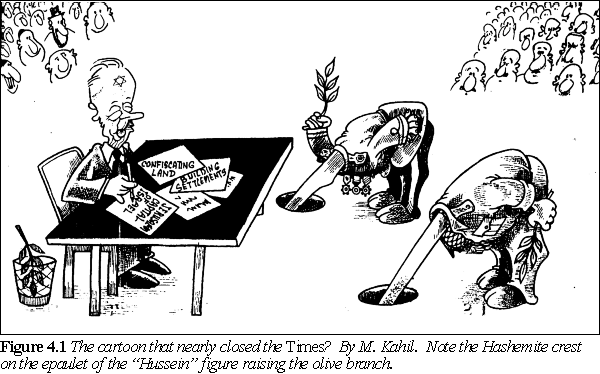 "Who was caricatured" in the M.
Kahil cartoon was apparently
King Hussein himself. Together
with Yasir Arafat, the Hashemite
monarch was burying his head in
the sand and proffering an olive
branch to Yitzhak Rabin, while
the Israeli Prime Minister
expropriated more land in the
vicinity of East Jerusalem. At
least, so it might seem to a close
observer:(160) Arafat was
identified by his distinctive
keffiyeh, and the Jordanian King
by the crown insignia on his
shoulder. Even apart from the
perhaps-unprecedented offense
against Hussein - the suggestion
that he was servile to the Israelis,
and blind to ongoing injustices
against the Palestinians - the
cartoon was inopportunely timed.
Al-Safadi's reference to "what had happened earlier" is explained by the fact that King Hussein had, before the cartoon appeared,
successfully negotiated a temporary repeal of the land-grab. "The cartoon did His Majesty the King a great deal of injustice," Al-Safadi acknowledged ruefully. For some hours, an atmosphere of crisis descended at the newspaper. But the Times was too favoured
a regime instrument, and the explanation for the misstep so innocuous, that the Ministry of Information never received instructions to
launch a prosecution under the PPL. "Being the magnanimous man he truly is," said Al-Safadi, the King "accepted our apology and
understood that it was an inadvertent error on our part."(161)
"Who was caricatured" in the M.
Kahil cartoon was apparently
King Hussein himself. Together
with Yasir Arafat, the Hashemite
monarch was burying his head in
the sand and proffering an olive
branch to Yitzhak Rabin, while
the Israeli Prime Minister
expropriated more land in the
vicinity of East Jerusalem. At
least, so it might seem to a close
observer:(160) Arafat was
identified by his distinctive
keffiyeh, and the Jordanian King
by the crown insignia on his
shoulder. Even apart from the
perhaps-unprecedented offense
against Hussein - the suggestion
that he was servile to the Israelis,
and blind to ongoing injustices
against the Palestinians - the
cartoon was inopportunely timed.
Al-Safadi's reference to "what had happened earlier" is explained by the fact that King Hussein had, before the cartoon appeared,
successfully negotiated a temporary repeal of the land-grab. "The cartoon did His Majesty the King a great deal of injustice," Al-Safadi acknowledged ruefully. For some hours, an atmosphere of crisis descended at the newspaper. But the Times was too favoured
a regime instrument, and the explanation for the misstep so innocuous, that the Ministry of Information never received instructions to
launch a prosecution under the PPL. "Being the magnanimous man he truly is," said Al-Safadi, the King "accepted our apology and
understood that it was an inadvertent error on our part."(161)
The symbiotic relationship between the regime which Hussein headed, and mainstream papers like the Times, was evident in virtually every area of Times content and institutional functioning. It certainly constrained Times reporting to more superficial treatments of systemic issues. In this context, the issue of corruption is worth focusing on briefly. As we saw in the first part of this chapter, corruption was one of the most contentious issues in the early post-liberalization era, and was seized upon by Jordan's self-perceived "democratizing" forces - including the Islamists, firebrand parliamentarians, and a new or newly-energized tabloid press eager to exploit the issue for its sensational value. In the case of the last of these, we saw earlier that tabloids like Shihan managed to inaugurate something of a "watchdog" model in the Jordanian press. They often made mainstream papers like the Times seem toothless, if professionally more scrupulous. Interestingly, the Times, perhaps more than any other mainstream daily, felt obliged to rise to the tabloid challenge. After all, it presented itself to readers as a reliable and professional source of information important to a liberalizing society. And corruption was one of the most society-driven of the new social issues and controversies. People at nearly all levels of Jordanian society were outraged by the notion of a poverty-stricken country being further sapped by self-interested public officials. At the same time, though, the issue inherently brought any investigator - including the investigative journalist - up against the traditional closed ranks of the elite, tight-lipped officials, and rigorous controls over access to "sensitive" information. How did the Times respond? In short: carefully, with no real attempt at the kind of investigation or specific denunciation that the tabloids sometimes undertook.
The Times did provide extended, incisive coverage of one of the largest corruption scandals of the immediate post-liberalization era. This involved Petra Bank, an institution taken over by the government in August 1989 after years of mismanagement and surreptitious capital flight. It was, noted a Times headline of July 1990, a "story ... of shady dealings, puzzling questions and chaos in account books."(162) But Times coverage followed in the train of the regime's belated investigations of itself, merely reporting the facts as announced to parliament. On other occasions, the Times appeared to downplay the extent and reach of corruption - even to argue that the issue had become too "politicized" and should be dropped altogether. As a new corruption law was debated in early 1993, the Times editorialized:
The fight against corruption in government is a worthy cause that obviously enjoys wide public support and is definitely prompted by so many stories and yet few proven cases of abuse of public office. But the crusade for clean government is also engulfed by political intrigue and sensationalism that might push some of us, like our honourable legislators, to cross the fine line of drafting effective anti-corruption laws into the domain of electioneering. ... To fight alleged corruption in the country [emphasis added], we do not need new laws at all. So why the two houses are bothered with debating the legislation in the first place is unknown to us.(163)
Another editorial, appropriately titled "Where to draw the line," saw the Times seeking to balance journalistic freedoms with the regime's putative right to secrecy:
Clearly, there are valid arguments for and against secrecy in debating sensitive issues that have affected each and every Jordanian in one way or another. ... The corruption issue is indeed delicate, and our parliamentarians are still novice[s] in parliamentary debates and lack enough experience in handling subjects of this magnitude. ... This does not mean that there will not come a point when event he secret parliamentary deliberations and findings will have to be made public. No useful purpose can be achieved by debating the issue of corruption totally in the dark [emphasis added], since this could give rise to fears and suspicions that a cover-up is being contemplated or that a 'deal' is in the making. ... If the House appears to have opted to brush under the carpet all the past wrongdoings, the deputies will have their constituencies to answer to when they are due for reelection.(164)
Once again, the chain of command extended no further than the parliamentary whipping-boy. But the Times did show itself able to alight on systemic issues, however briefly, when the biggest corruption scandal of the early 1990s erupted into the headlines. This swept up former Prime Minister Zeid Rifa'i and two former cabinet ministers, who were charged with "alleged misuse of authority [leading] to mismanagement of public funds in a multi-million dollar highway construction."(165) Wrote the Times:
In countries like Jordan, where the division of powers was not clear and only recently started to take shape, corruption was made possible by successive governments' overwhelming control on [sic] people's lives. It is politically accepted of course that where there is repression, corruption thrives. ... We find that corruption [in Jordan] is highly rampant. ... It has, over the years, become a norm, and perhaps a God-given right, for officials to use their positions to their own benefits. ... The amazing thing about all of this is that it is rarely possible to try anyone and convict him on these grounds. The system itself is not built to do so. ... The case currently being debated at the Lower House of Parliament, which concerns a former prime minister and two ex-ministers, should be used a sa model for investigating the loopholes in our system. Despite our belief that political and electoral gains are behind some of the motives to open the case, and the case itself may be weak, we are not [advocating] and would never advocate dropping it. But we dread the prospect that our Parliament should be wasting its and our time on a futile issue. ... No matter which way the case goes, it is the political and judicial system that needs to be tried, judged and ultimately corrected.(166)
But there was still palpable ambivalence about this "futile issue." The Times acknowledged the limitations on coverage, with a searching, implicitly self-critical commentary credited only to "a Jordan Times Staff Reporter." It was a sort of oblique systemic critique, seeking to suggest why no real systemic critique was possible:
The Jordanian media faced a crucial test in the past two weeks as the country's eyes and ears focused on the debate in Parliament over alleged corruption cases. And, for all practices purposes, the journalists failed to rise to the challenge in tackling an important issue in the democratic process, according to local and foreign media experts and observers. ... Varying reasons are put forward by media experts on why the journalists have fallen far short of playing their rightful role in the affair through running investigative reports and meaningful commentaries and analyses on the significance of the affair [emphasis added] ... The very fact that [such] a powerful Jordanian politician as former Prime Minister Zeid Rifa'i was implicated in the affair, coupled with the restrictions that were a way of life for the Jordanian media until 1989, seemed to have been a key factor in shaping the journalists' approach, according to some commentators. ... "Having displayed themselves as cowering against personal fears of consequences of crossing someone's path, the Jordanian press has played into the hand s of those who would like to muzzle it," [said one] journalist. Indeed, it was the first time that the Kingdom's media was exposed to an affair of such magnitude and political gravity, and therefore the journalists were at a loss to know how to handle the issue, some others say. Another major element also appeared to be considerations of the legal implications of carrying reports which could be deemed as defamatory, particularly [given] that the libel laws of Jordan are as fizzy [sic] if not fizzier [sic] than those of Western democracies. ... The fact that Mr. Rifa'i issued a statement signalling a comeback is enough reason for chief editors, writers and commentators to justify their refraining from delving into the issue, according to one managing editor of a local daily. ... Another reason the managing editor cited was an apathy altogether towards the democratisation process and scepticism that the whole process might be turned back.(167)
It was precisely this fear that the limited but real freedoms in King Hussein's Jordan "might be turned back" that appears to have reined in the Times' corruption coverage - still more so that of the Arabic-language dailies. Whether the paper, along with other media in Jordan, might have pushed the boundaries further is moot. "Before the whole thing could really mushroom into something that would have touched the basic pillars of society," said P.V. Vivekanand, "the Iraqi invasion of Kuwait came along. So the focus shifted, and corruption was put on the back burner." In August 1992, 16 of those tried in the Petra Bank scandal were indicted on "various counts of embezzlement, fraud, and breach of trust." In November 1992, King Hussein laid the issue to rest, offering a royal amnesty to all those convicted. The Times, loyally and predictably, expressed its approval, calling Hussein's announcement "a testimony of the King's compassion towards his subjects and an example of his political acumen and foresight."(168)
It is important to acknowledge the difficulty of generalizing from the Times' experience to that of the Jordanian press as a whole over the past decade. (Hence my pains to present a general view of this media system in the first part of the chapter.) The stop-and-start, highly-manipulated nature of the Jordanian liberalization also means that transformations at the Times are not nearly as dramatically evident as in most of the other case-studies in this work. Despite these obstacles, though, the case of Jordan Times seems worthwhile to a comparative study of the press in transition. Like the Jordanian liberalization as a whole, the paper can be seen as a kind of "control" for the other case-studies. On its own terms, the Times, like Barricada, serves as a fine example of a newspaper working to expand its limited institutional resources and widen its professional purview under conditions of limited liberalization. Like other Jordanian media and social forces, the Times has been subject to bouts of renewed regime constraint and attempted "rollbacks" of democratic gains. But however one might evaluate events in Jordan as a whole over the last decade or two, the balance sheet for the Times is surely a positive one. The paper is considerably larger (it has tripled in size since 1975); better-funded; more professionally adept; and somewhat more widely-read than at the "onset" point of the liberalization process. And it has striven reasonably energetically to inculcate political and social values more liberal and humane than those that currently prevail in Jordan. This is a subjective judgment, to be sure. But it is hardly irrelevant to a discussion of "liberalization" - a standard precondition, if neither a necessary nor a sufficient one, for political transition.
Ayalon, Ami. The Press in the Arab Middle East: A History. New York and Oxford: Oxford University Press, 1995.
Boyd, Douglas. Broadcasting in the Arab World. Philadelphia: Temple University Press, 1984.
Garon, Lise. "The Press and Democratic Transition in Arab Societies: The Algerian Case." In Rex Brynen, Bahgat Korany, & Paul Noble, eds., Political Liberalization & Democratization in the Arab World (Boulder and London: Lynne Rienner Publishers, 1995), pp. 149-165.
"A Censor's Testimony: 'Journalists in Syria are an extinct species'." Middle East Report, November-December 1987, pp. 42-43.
Koeppel, Barbara. The Press in the Middle East: Constraint, Consensus, Censorship. A Special MERIP Publication. Washington, DC: Middle East Research & Information Project, 1987.
Rugh, William A. The Arab Press, 2nd rev. ed. Syracuse: Syracuse University Press, 1987.
Vivekanand, P.V. "Despite its shortcomings, Jordan's new press law more progressive than Arab equivalents." Jordan Times, 17 May 1993.
Andoni, Lamis. "Jordan." In Rex Brynen, ed., Echoes of the Intifada: Regional Repercussions of the Palestinian-Israeli Conflict. Boulder, CO: Westview Press, 1991.
Amawi, Abla. "Democracy Dilemmas in Jordan." Middle East Report, January-February 1992, pp. 26-29.
Brynen, Rex. "Economic Crisis and Post-Rentier Democratization in the Arab World: The Case of Jordan." Canadian Journal of Political Science, 25: 1 (March 1992), pp. 69-97.
Hawatmeh, George. "An edgy regime." Middle East International, 9 June 1995, pp. 9-10.
Jordan's Parliamentary Elections, 8 November 1993. Amman: Jordan Media Group, 1993.
The Jordanian National Charter. Amman, December 1990.
Rath, Kathrine. "The Process of Democratization in Jordan." Middle Eastern Studies, 30: 3 (July 1994), pp. 530-557.
Robinson, Glenn E. "Defensive Democratization in Jordan" (ms.).
Rabinovich, Hamar and Haim Shaked, eds. "Jordan (Al-Mamlaka al-Urdunniyya al-Hashimiyya)." Middle East Contemporary Survey, 9 (1984-1985). Tel Aviv: Tel Aviv University, 1987.
Shaked, Haim and Daniel Dishon, eds. "Jordan (Al-Mamlaka al-Urdunniyya al-Hashimiyya)." Middle East Contemporary Survey, 8 (1983-1984). Tel Aviv: Tel Aviv University, 1986.
Susser, Asher. "Jordan (Al-Mamlaka al-Urdunniyya al-Hashimiyya)." In Ami Ayalon, ed., Middle East Contemporary Survey 16 (1992). Boulder, CO: Westview Press, 1995.
-----. "Jordan (Al-Mamlaka al-Urdunniyya al-Hashimiyya)." In Ami Ayalon, ed., Middle East Contemporary Survey, 15 (1991). Boulder, CO: Westview Press, 1993.
-----. "Jordan (Al-Mamlaka al-Urdunniyya al-Hashimiyya)." In Ami Ayalon, ed., Middle East Contemporary Survey, 13 (1989). Boulder, CO: Westview Press, 1991.
Al-Tawalbah, Dr. Abdullah. The Jordanian Democratic March Toward Rooting and Comprehensiveness. Amman: Press and Publications Department, December 1994.
White Paper: Jordan and the Gulf Crisis, August 1990-March 1991. Amman: The Government of the Hashemite Kingdom of Jordan, August 1991.
Al-Sharif, Osama. "The press, Government and future challenges." The Star (Amman), 28 December 1995.
Andoni, Lamis. "The history of the English-language press in Jordan and Palestine." The Jordan Times, 26 October 1995 (20th anniversary edition).
"Censorship and self-censorship." In The media and the peace process in the Middle East, Contributions from participants in the seminar organised by Reporters sans Frontières, 25-28 July 1994.
Hawatmeh, George, "The changing role of the press: Jordan's experience since 1989." The Jordan Times, 26 October 1995.
-----, ed. The Role of the Media in a Democracy: The Case of Jordan. Proceedings of a seminar organised by the University of Jordan in cooperation with the Konrad Adenauer Foundation, 27-28 September [1994], Amman. University of Jordan Center for Strategic Studies, 1995.
-----. "The story of the Jordan Times." The Jordan Times, 26 October 1995 (20th anniversary edition).
Jones, Adam. "Liberal journalism, Jordanian style." Jordan Times 20th Anniversary Supplement, 26 October 1995.
Jordan: Critique of the Draft Press and Publications Law. London: Article 19 International Centre Against Censorship, 7 December 1992.
Jordan: Democratization without Press Freedom. London: Article 19 International Centre Against Censorship, Issue 33, 22 March 1994.
Khouri, Rami G. "The 'beauty' of Jordan's press law." The Daily Star, 12 August 1998 (Daily Star Online, <http://www.dailystar.com.lb/opin100598/o081298a.htm>).
"A Policeman on My Chest, A Scissor in My Brain: Political Rights and Censorship in Jordan." (By "A Special Correspondent.") Middle East Report, November-December 1987, pp. 30-34.
Senfft, Alexandra. Die gegenwärtige Situation der Presse in Jordanien. Hamburg: Deutsches Orient-Institut, 1989.
"'Text' of Press, Publication Draft Law." Foreign Broadcast Information Service, 19 March 1993 [from Sawt Al-Sha'b, in Arabic, 15 March 1993].
ALAMI, Sharif. Financial Manager, Jordan Press Foundation. Amman, 22 July 1995.
AMIN, Mohammad. Director General, Department of Press and Publications, Ministry of Information. Amman, 3 August 1995.
HASANAT, Abdullah. General Manager, The Jordan Times. Amman, 5 July 1995.
HAWATMEH, George. Chief Editor, The Jordan Times. Amman, 15 July, 2 August, 23 August 1995.
HENDERSON, Amy. Staff Writer, The Jordan Times. Amman, 8 July 1995.
HOURANI, Nader. Deputy Director General, Jordan Press Foundation. Amman, 22 July 1995.
HUSSEIN, Oudah. Advertising Manager, The Jordan Times. Amman, 20 July 1995.
IMMENKAMP, Beatrix. Staff Writer, The Jordan Times. Amman, 22 July 1995.
KHOURI, Rami G. Columnist, former Chief Editor, The Jordan Times. Interview by e-mail: questions submitted 23 August 1995; answers supplied 8 November 1995.
KILANI, Sa'eda. Staff Writer, The Jordan Times. Amman, 14 July 1995.
KING, Cathy. Staff Writer, The Jordan Times. Amman, 7 July 1995.
MANSOUR, Nidal. Chief Editor, Al-Hadath. Amman, 29 July 1995.
MAWLA, Nayef K. Secretary General, Ministry of Information. Amman, 20 August 1995.
MOMANI, Jehad. Chief Editor, Shihan. Amman, 24 August 1995.
QUDAH, Suleiman. Chief Editor, Al-Ra'i; President, Jordan Press Assocation; President, International Organization of Journalists. Amman, 15 July 1995.
SA'DI, Walid M. Columnist and editorial writer, former Chief Editor, The Jordan Times. Amman, 2 August 1995.
AL-SAFADI, Ayman. Editorial Page Editor, Senior Political Writer, The Jordan Times. Amman, 19 August 1995.
AL-SHARIF, Nabil. Chief Editor, Al-Dustur. Amman, 24 July 1995.
VIVEKANAND, P.V. Political Editor, The Jordan Times. Amman, 9 August 1995.
VOSKIAN, Ara. News Editor, The Jordan Times. Amman, 7 July 1995.
Created by Adam Jones, 1999. This material is copyright 1999. Please contact the author for permission to copy or distribute it.
 adamj_jones@hotmail.com
Last updated: 10 October 2000.
2. Jack Redden, "Security gets tighter in King Hussein's Jordan," Reuters dispatch, 2 July 1995.
3. Sa'eda Kilani, "House discusses Khalifeh case and law on telecommunications," Jordan Times, 17-18 August 1995.
4. Glenn E. Robinson, "Defensive Democratization in Jordan," unpublished paper, pp. 1, 20. Guillermo O'Donnell and Philippe C. Schmitter's definition of a "transition" suggests that Jordan has not experienced one: "It is characteristic of the transition that during it the rules of the political game are not defined. Not only are they in a constant flux, but they are usually arduously contested ..." In Jordan since 1989 the "rules of the political game" have been very much defined, and largely adhered to by the various actors. O'Donnell and Schmitter, Transitions from Authoritarian Rule: Tentative Conclusions about Uncertain Democracies (Baltimore and London: The Johns Hopkins University Press, 1986), p. 6.
5. Hawatmeh, "The changing role of the press," p. 7.
6. Hawatmeh also placed the Khalifeh killings in the context of the regime's growing intolerance of dissent: "The shoot-out ... reinforced the belief that the strain created by the signing of the treaty was growing rather than lessening with the passage of time." Hawatmeh, "An edgy regime," Middle East International, 9 June 1995.
7. "A Censor's Testimony: 'Journalists in Syria are an extinct species,'" Middle East Report, November-December 1987, p. 42 (also Index on Censorship, June 1987).
8. P.V. Vivekanand, "Despite its shortcomings, Jordan's new press law more progressive than Arab equivalents," Jordan Times, 17 May 1993. This article provides a good brief overview of media in the Arab World. For more substantial investigations, see William Rugh, The Arab Press, 2nd rev. ed. (Syracuse: Syracuse University Press, 1987); Barbara Koeppel, "The Press in the Middle East: Constraint, Consensus, Censorship," A Special MERIP Publication, 1987.
9. See, e.g., John West, "Palestinian Newspaper Closes Under PLO Ban," Reuters World Report, 31 July 1994; Eileen Alt Powell, "Palestinian Censorship," Associated Press dispatch, 5 August 1994.
10. "Freedom House lauds Jordan media reforms," Jordan Times, 12-13 May 1994.
11. Quoted in Jordan Times, 26-27 March 1992 (FBIS, 27 March 1992).
12. Lamis Andoni, "Investigative reporting in the Jordanian press," in Hawatmeh, ed., The Role of the Media in a Democracy, p. 25.
13. According to George Hawatmeh, broadcast media are used to "winning sporadic freedoms in covering news and views depending on which prime minister and minister of information are in office at the time." Hawatmeh, "'The changing role of the press - the Jordanian experience since '89," in Hawatmeh, ed., The Role of the Media in a Democracy, p. 4.
14. Petra, established in 1969, employs 170 staff, including 100 journalists and seven foreign correspondents. It generates about 200 stories per day. See "King congratulates Petra on 25th anniversary," Petra dispatch in Jordan Times, 17 July 1994.
15. As noted, estimates vary. Nabil al-Sharif, editor of Al-Dustur, claimed in 1994 that government ownership figures were 60 percent for Al-Ra'i and 40 percent for Al-Dustur, and that the figure for Sawt Al-Sha'b had been 75 percent. (Rana Husseini and Cathy King, "Role of Jordanian media in limelight at 'Scientific Week,'" Jordan Times, 27 November 1994). In an interview (Amman, 24 July 1995) al-Sharif cited figures of 35 percent for Al-Dustur and 65 percent for Al-Ra'i. 1990 figures cited by the Jordan Times (Rabab Mango, "Government to study ownership of press," 8 January 1990) gave the following estimates: 61 percent Al-Ra'i, 53 percent Al-Dustur, and 85 percent Sawt Al-Sha'b. Al-Ra'i's editor, Suleiman Qudah, claimed 62 percent Al-Ra'i, 45 percent Al-Dustur, and 67 percent Sawt Al-Sha'b before its closure (interview, Amman, 15 July 1995).
16. Article 19, Jordan: Democratization without Press Freedom, 22 March 1994, p. 5.
17. Advertising constituted 63 percent of the JD 8.5 million (about C $17 million) earnings of the Jordan Press Foundation (publisher of Al-Ra'i and Jordan Times) in 1994. The boom in advertising contributed to the JPF's "84 per cent increase over the previous JD 1.5 million record [profit] posted at the end of 1992." Samir Shafiq, "Jordan Press Foundation hikes pre-tax profit by 84 per cent," Jordan Times, 29 March 1994. To my knowledge, no reliable estimate of government versus "private" advertising revenue exists. But since government and the upper reaches of private business are so interwoven to begin with, such distinctions may not be very useful. Al-Ra'i, the regime's flagship publication, is certainly the fattest Jordanian paper, and the one most flush with corporate and commercial advertising.
18. "'A Policeman on My Chest, A Scissor in My Brain': Political Rights and Censorship in Jordan," Middle East Report, November-December 1987, p. 33.
19. See "A Policeman on My Chest ..." Ayman Al-Safadi of the Jordan Times made a similar point: "To bring about a change in the perception of your role, from a government spokesman whose job is merely to report what the government does, into a watchdog of a sort, into the role the press really has to have in any democratic society - to seek information to expose public officials and how they're conducting their business - that takes a mentality change which has not been very fast in coming, unfortunately."
20. Jordan Times Managing Editor Abdullah Hasanat has written that "Ministers and heads of government departments, being accustomed to long membership in the bureaucracy and entrenched in the system they serve, are fearful they might, if they talk, say the wrong thing. ... There is apparently a doctrine, held by most officials and civil servants, that the press has sinister aims and should not be given any information." Hasanat, "Access denied," Jordan Times, 29 December 1994. Hasanat told Article 19 that "There is no freedom of information act in the country and the material that you are after is not your right as a journalist. You have to use devious methods to get it or you have to use favours or you have to use connections, but it is not your right basically. This is the problem." Article 19, Jordan: Democratization without Press Freedom, p. 14.
21. Article 19, Jordan, p. 14.
22. This is of course true to a certain degree in all the case-study countries, but is carried furthest in the Jordanian media, I believe.
23. For an analysis, see Rex Brynen, "Economic Crisis and Post-Rentier Democratization in the Arab World: The Case of Jordan," Canadian Journal of Political Science, 25: 1 (March 1992), pp. 68-97.
24. Walid Sa'di, "Election results - a first look," Jordan Times, 11 November 1989.
25. Asher Susser, "Jordan," in Ami Ayalon, ed., Middle East Contemporary Survey (hereafter, MECS), 15 (1991) (Boulder, CO: Westview Press, 1993), p. 496.
26. For an excellent overview of the changes to the electoral law, see "Jordan's Parliamentary Elections, 8 November 1993," a publication of the Jordan Media Group (Amman, 1993). See also the coverage in the Jordan Times, 18 August 1993 (in FBIS, 18 August 1993). Rana Sabbagh notes that "A voter who once cast extra votes on an ideological basis, is now expected to use his [or her] single vote for a member of the tribe" ("Jordan Tribes Hold Key to Multi-Party Election," Reuters dispatch, 6 November 1993). A dissenting view, in my opinion not one borne out by subsequent events, is Maryam Shahin, "Tribes, Parties Seen Weakened by Election Law," Jordan Times, 4-5 November 1993 (FBIS, 5 November 1993).
27. A good overview of the drafting of the Charter is Robinson's. He notes not only that "it is a remarkably progressive document," but that "what gives the National Charter status is its collection of signatories," ranging from "not just ... well-known government and business figures close to the king, but a number of prominent figures from leftist parties and the Muslim Brethren as well." Robinson, "Defensive Democratization in Jordan," p. 7.
28. "... glasnost, too," Jordan Times, 12 December 1989.
29. Quoted in "A Policeman on my Chest ...," p. 33.
30. Lamis Andoni, "Jordan," in Rex Brynen, ed., Echoes of the Intifada: Regional Repercussions of the Palestinian-Israeli Conflict (Boulder, CO: Westview, 1991), p. 174. The editor notes that Andoni herself "had her press credentials and passport withdrawn, and was banned from working for the local media. She was also repeatedly questioned by Jordan security services, and publicly accused by then Information Minister Hani Khasawna of being a 'liar and a traitor'" (p. 174n).
31. Asher Susser, "Jordan," in Ami Ayalon, ed., Middle East Contemporary Survey, 13 (1989), p. 459.
32. Ghadeer Taher, "Ministry of Information studies plans to revamp role, structure," Jordan Times, 14 January 1990.
33. Susser, "Jordan," p. 459.
34. Mitchell Stephens, A History of News (New York: Penguin Books, 1988), p. 98.
35. Al-Dustur editorialized: "If some are inclined to blame Iraq, we remind those of the train of events that preceded those that took place at dawn yesterday [the Iraqi invasion]. We also urge them not to ignore a long series of moves that have been taking place against the legitimate rights of Iraq, a matter that compelled Iraqi political decisionmakers to make this move and that prompted Iraq to move to defend Iraq's interests and natural rights." Al-Ra'i and Al-Dustur excerpts translated in "Newspapers Support Iraqi Invasion of Kuwait," FBIS, 3 August 1990.
36. Editorial, "Problem's in the root," Jordan Times, 5 August 1990.
37. Susser, "Jordan," MECS 16 (1995), p. 542.
38. Editorial, "Time for soul-searching," Jordan Times, 3 March 1991.
39. Khalil Mahmoud, "How the press has fared since 1989" (floor discussion), in Hawatmeh, ed., The Role of the Media in a Democracy, p. 28.
40. Walid M. Sa'di, "Jordan's press during the Gulf crisis: A faithful mirror of people's sentiments," Jordan Times, 13 May 1991.
41. Sa'di, "Jordan's press during the Gulf crisis."
42. Robinson, "Defensive Democratization in Jordan," p. 10.
43. For a complete, fairly up-to-date listing, see the "List of Legalized Jordanian Political Parties" (and their newspapers) in FBIS, 1 February 1995.
44. Amin's counterpart at the ministry, Secretary General Nayef Mawla, distinguished between "professional" newspapers that "increase the level of information the average person has" without "blowing things out of proportion," and tabloids that are "based on only sensationalism" and "only looking to increase their sales."
45. The paper distributed 100,000 copies weekly inside Jordan as of mid-1995, with occasional surges to 200,000 when major events occurred (such as the defection of Saddam Hussein's son-in-law to Jordan in August 1995). By comparison, Al-Ra'i, the largest daily, printed 90,000 copies a day. Jehad Momani interview; "Al-Ra'i Facts and Figures" (Jordan Press Foundation advertising brochure), privately supplied.
46. Shihan, 20 January 1994. For a summary in English, see Ayman al-Safadi, "Malhas laments deficiencies of laws to protect consumers in food, drugs," Jordan Times, 22 January 1994, and follow-up coverage (including the Times' own investigations) in the editions of 24, 25, and 26 January, 3-4 February, and 7 February.
47. Sa'eda Kilani, "Information minister pledges more cooperation with the press," Jordan Times, 21 January 1995.
48. "There was once a mistake when a coloured photo of a woman was published in black and white. It made her look as if she were not wearing anything," Momani told the Jordan Times. However, "Mr. Momani admitted this was not the only time [the mixup had occurred]. The weekly ... also published photos of women on Eilat beach a couple of months ago." Sa'eda Kilani, "JPA warning to 3 weekly tabloids stirs controversy," 10 January 1995.
49. See Rana Husseini, "Specialists assail press coverage of Zarqa child murder," Jordan Times, 2 April 1994. The quoted comments by Rifai are the Times' paraphrase.
50. With regard to the claim of a "broad spectrum" of readership, Momani stated that the addition of political coverage "talking about political problems after the advent of democracy," together with design changes, allowed Shihan to reach beyond its original traditional lower- and lower-middle class audience. Poorer newspaper readers, of course, were more likely to choose a weekly paper over a daily. As for advertisers' original reluctance to come on board, Momani recalled: "We found at first a big problem [in attracting advertising]. The people who have the money and factories would think twice when they wanted to advertise with our paper, because we were opposed to the government. The government is always friends with capital, as you know." Greater success in recent times, he said, reflected "over three years of working with [advertisers] to convince them that we are a national [i.e., loyal] opposition, [that] we are working for our country and for the sake of our people."
51. According to Suleiman Qudah: "[Al-Hadath] is very good. It is very serious, and it has a lot of courage in the things it says about politics. It is completely different from the other [weeklies]."
52. Muhammad Ayish, a professor of Journalism and Mass Communications at Yarmouk University, has argued that the Law must be "understood within the framework of a long record of cynicism and mistrust characterising the press relationship with [the] people's representatives [in parliament] from the outset of the country's democratisation process." According to Ayish, parliamentary modifications included clauses "relating to source revelations, criteria for publishing information and [the] definition of a professional journalist." Ayish, "Press and Parliament - the uneasy relationship," Jordan Times, 23 December 1992. George Hawatmeh has also claimed that "apparently, the version [of the law] that was approved was much worse than the one that was [originally] presented to the government. What happened there, we don't know. It's a big indication, though, that relations between parliamentarians and the press were so tense that the parliamentarians had to tighten the screws more than the government did."
53. On the Muslim Brotherhood's concerns, see Ziad Abu Ghanimeh, "The Islamists' voice is not being heard," in Hawatmeh, ed., The Role of the Media in a Democracy, pp. 59-62. The complaint has been raised more generally by the political opposition throughout the liberalization era. Parliamentary hostility towards the press broke into the open in a Lower House debate of March 1992 in which, "in an unprecedented attack on local media organisations, many deputies blamed the press and the government-run radio and television networks for being mouthpieces of the executive authority and tools of well-to-do newspaper owners" (Jordan Times, 26-27 March 1992, in FBIS, 27 March 1992). In July 1994, a group of "political leftist, pan-Arab, and Islamic parties" presented a memorandum to then-Information Minuister Dr. Jawad al-'Anani. "The memorandum said these parties do not object to the government's right to express its view [on peace negotiations] ... but these parties do not accept the government claim that through its position and media it represents all the people; they do not agree to the government's turning its back on national Jordanian establishments, represented by political parties, social figures, and trade unions that have expressed their position on the Jordanian-Israeli negotiations." Sawt Al-Sha'b, 28 July 1994 [in Arabic]; quoted in FBIS, 29 July 1994.
54. The specific language of the Law concerning foreign ownership or contributions reads as follows (Article 44): "The owner of any press publication, or its chief editor, managing editor, or any other editor, correspondent, or regular writer ... is prohibited from receiving any financial aid or gift from any local or foreign party without the minister's approval."
55. All quotes from the Press and Publications Law of 1993 "as approved by both houses of parliament" are drawn from "'Text' of Press, Publication Draft Law," FBIS, 19 March 1993.
56. Nermeen Murad, "'Unrecognised' journalists launch battle against JPA's monopoly," Jordan Times, 24 August 1992.
57. Ayman al-Safadi, "The Draft Press Law: A Giant Step Backwards," Jordan Times, 20-21 August 1992 (FBIS, 20 August 1992).
58. Editorial, "Black day for the press," Jordan Times, 28 December 1992.
59. Article 19, Jordan: Critique of the Draft Press and Publications Law, December 1992, pp. 1, 5.
60. Robinson, "Defensive Democratization in Jordan," p. 9.
61. Between the May 1993 implementation of the law and April 1994, UPI estimated "more than 10 cases" in total of prosecution under the PPL, "against mainly tabloid and political party newspapers." Richard Purdy, "Two Jordanian journalists go on trial," UPI dispatch, 18 April 1994.
62. "Report by the Public Liberties Committee of the Jordanian House of Representatives," 26 August 1991; published in Al-Ribat [in Arabic], 10 September 1991 (FBIS, 12 September 1991). The report pulled few punches, claiming that "to date, the measures being adopted to restrain citizens' liberties violate most international laws, accords, and charters concerning civilian and political rights." It described two unregistered detention facilities of the General Intelligence Department (GID), including "a torture place called 'the square'," and named the slang terms for the tortures allegedly carried out there. It demanded that "the government ... issue instructions to all its executive agencies to stop collecting information by detention and torture, which has become the principal method of collecting information by departments set up" for that purpose.
63. Amman Jordan Television Network [in Arabic], 11 September 1991 (FBIS, 12 September 1991).
64. Like Al-Ahali, the organ of the Jordanian Popular Democratic Party, Al-Ribat operated on the margins of the Jordanian media system, being registered overseas - in Greece - and rolling off presses in the Zarqa free trade zone. The authorities therefore had some difficulty in launching formal proceedings against it, and relied instead on confiscations of the finished product.
65. Jordan Times, 19 September 1992 (FBIS, 21 September 1992).
66. Jordan Times, 27 September 1993 (FBIS, 28 September 1993).
67. Jordan Times, 29 September 1993 (FBIS, 29 September 1993).
68. Jordan Times, 11 October 1993 (FBIS, 13 October 1993).
69. "Two journalists convicted under Jordan's press law," Reuters dispatch, 16 May 1994; "Jordanian reporters lose appeal," UPI dispatch, 20 June 1994.
70. Jordan Times, 17 February 1992 (FBIS, 20 February 1992).
71. "Edition of Al-Ribat Banned," Jordan Times, 21 November 1992 (FBIS, 24 November 1992).
72. Shihan, 14-20 January 1995 (FBIS, 13 January 1995).
73. Sa'eda Kilani, "JPA board member resigns in protest," Jordan Times, 2-3 March 1995.
74. Jordan Times, 17 February 1992 (FBIS, 20 February 1992).
75. Editorial, "Zone for free thought," Jordan Times, 17 December 1992.
76. Editorial, "Changing times, same habits," Jordan Times, 4 June 1993. See also the editorial of 16 August 1993, "Brutality breeds violence."
77. It would be another matter entirely for the Times to commission an independent report of torture allegations per se (i.e., not the second-hand dissemination of court proceedings). The prosecutions of 1994 brought the paper to heel long before such a point was reached, in the unlikely event that it was ever contemplated.
78. Elsewhere in parliament, such probing is of course welcomed by the Islamists and other opposition forces, for whom it provides useful ammunition. But owing to the fact that they have largely been frozen out of high government positions, with the brief exception of Mudar Budran's Gulf War cabinet, the Islamists should not be counted as part of this establishment bloc; possibly the more supine Islamic Brotherhood hierarchy of years past would qualify. In any case, the Islamists have their own grudge against the press.
79. Jordan Times, 29 November 1994 (FBIS, 1 December 1994).
80. Prosecutor-general's charge sheet, cited in Rana Sabbagh, "Jordan Brings Charges Against British Paper," Reuters dispatch, 22 October 1995.
81. The corruption theme is explored further in the Jordan Times case-study, below.
82. Literally, given the time-honoured relationship between the Hashemite monarchy and the Muslim Brotherhood.
83. Even the most combative editor in the country acknowledged this. "We're the first newspaper to tell the Prime Minister of Jordan, 'You are wrong,'" said Jehad Momani of Shihan. "We couldn't, of course, tell the King that he is wrong, under the law. He's above all that." It hardly needs to be added that the King is also above the merest hint of prurient tabloid reporting of his private life - the lot of royalty and celebrity elsewhere in the world.
84. It has ever been thus in Jordan: Kathryn Rath notes that during the 1989 unrest, "The king was not directly attacked ... A distinction was made between the king and the government, and it was towards the latter that the anger was directed. In the undemocratic system, the royally-appointed government served as a safeguard against popular discontent." In the new semi-democracy, a compliant, comparatively freely elected parliament has served much the same function. Rath, "The Process of Democratization in Jordan," Middle Eastern Studies, 30: 3 (July 1994), p. 542. See the discussion of "demipoliticization" in Chapter 6.
85. FBIS, 9 September 1992.
86. Asher Susser, "Jordan," in Ami Ayalon, ed., Middle East Contemporary Survey, 16 (Boulder, CO: Westview Press, 1995), p. 535.
87. "Objectionable pseudo-objectivity," Jordan Times, 12 September 1992.
88. See the summary in Susser, "Jordan," MECS, 16 (1995), pp. 537-538.
89. Thus 'Alia Al-Hussein's claim that Khouri's comments are "completely irresponsible ... especially in that the Jordan Times is the Jordanian paper that is most read outside the country in important circles." See also the letter from Flavia Tesio Romero ("Not so elegant or humble," Jordan Times, 13 September 1992): "Why was it [the article] written in English, in the Jordan Times? What audience was it meant to reach?"
90. Note in Khouri's analysis that the monarch's own sensitivities are secondary, causally, to the ire of "the establishment," craven "officials," "tribal and patriarchal" elements, "the system."
91. Rami Khouri, "Once Again, With A Bit More Clarity ...," Jordan Times, 15 September 1992 (FBIS, 16 September 1992).
92. Khouri, "The media, the past and the challenge," Jordan Times, 19 April 1994.
93. "In order to discourage underground printing and distribution of banned or unlicensed books, the DPP launched a campaign directed at printers warning them against printing unauthorized material. In January 1994, the DPP placed newspaper advertisements warning owners and managers of printing houses, photocopying offices and advertising agencies against printing any book or other publication without the authorization of the Department." Article 19, Jordan: Democratization without Press Freedom, p. 17.
94. Article 19, Jordan, pp. 18-19.
95. Nabil Al-Sharif, "Opposition in the print media," in Hawatmeh, ed., The Role of the Media in A Democracy, p. 11.
96. "Information Minister Speaks on Media Role in Gulf," FBIS, 14 December 1990.
97. In Momani's words: "Sometimes, when there is a very sensitive thing ... for example, after the signing of the Jordan-Israeli peace treaty was signed, Yediot Ahranot or Ha'aretz, one of the Israeli papers, published a photo of King Hussein and Yitzhak Rabin. In the photo, King Hussein was lighting Rabin's cigarette. I had the photo. And it was not very complimentary towards the King, not very flattering. He is the King, and he's lighting someone's cigarette! So I received a call from Mohammad Amin. He told me, 'Please, please, don't publish this photo.' I told him, 'I never planned to publish it, because it's not my policy [to embarrass the Royal Family].'"
98. Article 19, Jordan: Democratization without Press Freedom, p. 9.
99. Reporters Sans Frontières, "The media and the peace process in the Middle East," p. 20.
100. See Article 19, Jordan: Democratization without Press Freedom, p. 6.
101. Sa'eda Kilani, "Al Bilad wins court case, intends to sue for damages," Jordan Times, 9 May 1995.
102. Of particular note is the JPA's contemptuous attitude towards the popular press. This was evident in the campaign the JPA launched against the tabloids (notably Shihan, Al-Bilad and Hawadeth Al-Sa'ah) in January 1995, invoking the PPL and accusing the weeklies of exaggerating facts and printing material that "infringe[s] upon the general ethics and moral standards" of Jordanians. The campaign resulted, in March, in the resignation of JPA board member Musa Hawamdeh, a columnist for Al-Dustur. Hawamdeh went public with harsh accusations against the Association, claiming the JPA had been "transformed into another department of the Ministry of Information" and "used as the means to muzzle all voices that oppose the government." Nidal Mansour of Al-Bilad similarly accused the JPA of complicity in regime designs "to muzzle freedom of speech under the slogan of protecting public freedoms." Sa'eda Kilani, "JPA board member resigns in protest over 'cooperation in curtailing press'," Jordan Times, 2-3 March 1995. Hawamdeh claimed, accurately, that "It [the JPA and regime actions against the tabloids] is not a story of publishing obscene photos or fabricated crimes. They are targeting opposition papers because they publish true and real information that has never been published before and that influences decision makers."
103. Rami G. Khouri, "The 'beauty' of Jordan's press law," The Daily Star, 12 August 1998 (The Daily Star Online, <http://www.dailystar.com.lb/opin100598/o081298a.htm>).
104. "Jordan: A Death Knell for Free Expression? The New Amendments to the Press and Publications Law," Human Rights Watch/Middle East, 9: 5(E), June 1997, p. 8.
105. "Jordan: A Death Knell for Free Expression?," pp. 4-5.
106. Quoted in "Jordan: A Death Knell for Free Expression?," p. 8.
107. Quoted in "Jordan: A Death Knell for Free Expression?," p. 7.
108. See Committee to Protect Journalists, "Jordan: Country Summary," 1996 <http://www.cpj.org/ attacks96/countries/middleast/jordanrhs.html>.
109. Quoted in "Jordan: A Death Knell for Free Expression," p. 4.
110. "Jordan: A Death Knell for Free Expression?," p. 3.
111. Specifically, the publication accused Abdul Hadi al-Majali, the Minister of Municipal and Rural Affairs, of stealing cars during his stint as head of the Public Security Department in the 1980s. See Sana Abdallah, "Jordanian editor's release sought," UPI dispatch, 29 January 1997 (clari.world.mideast.misc).
112. "CPJ Calls for King Hussein to Halt State Prosecution of Journalists," CPJ News Alert, 28 March 1997 <http://www.cpj.org/news/jord032897.html>.
113. "Jordan suspends 10 weekly newspapers under new press rules," AFP dispatch, 24 September 1997 (clari.biz.industry.media).
114. "Jordan: Censored," The Economist, 12 September 1998.
115. Ironically, it is the least developed of the four, Nicaragua, that stands the best chance of holding together.
116. A possible outcome would be a southern Hashemite core, with a West Bank-affiliated central section and a small northern zone annexed to Syria. The worst-case scenario was widely bandied about at the time of King Hussein's death, and I claim no originality for it.
117. "Founders recall birth of a unique experiment," Jordan Times (hereafter, JT), 26 October 1995.
118. "We thought the Jordan Times had to be different from the Arabic-language press, because of its predominantly foreign-language press, because of its predominantly foreign audience. We would have limited credibility if we limited ourselves to mirroring government viewpoints." Rami Khouri, "From the '70s to the '90s: Changing with the Times," JT, 26 October 1995.
119. In an article for the Times' 20th-anniversary edition, I wrote that the paper's international coverage was "better than any newspaper in Canada, in my opinion." (See Adam Jones, "Liberal journalism, Jordanian style," Jordan Times, 26 October 1995.) The appraisal of the Larnaca-based Michael Jansen, in the same edition of the Times, is worth citing: "Reading the Times, posted to me in Cyprus where it arrives erratically and often very belatedly, helps me to function as a Middle East correspondent for The Irish Times of Dublin, a paper I also greatly admire for its serious and extensive coverage of foreign news, and particularly of developments in this region. ... The fact that I still read issues of the Jordan Times when they arrive weeks, or even months, late, shows that its reporting serves as excellent background to current happenings."
120. Rami Khouri, "From the '70s to the '90s: Changing with the Times," JT, 26 October 1995 (20th-anniversary edition). George Hawatmeh said in an interview: "This is realpolitik. You have to do it, even in the press. ... You can contribute more by being aware of your own role, by playing ball with the rest, but also getting your spin on it. That's infinitely more useful. We're not confrontational. If anyone tells you that this newspaper, the Jordan Times, is confrontational, don't believe them."
121. Jansen, "Keeping track ..." According to Musa Keilani, publisher and chief editor of the weekly Al-Urdun, "The nearly dozen English-language newspapers in the Gulf states focus mostly on external issues. ... Burning political issues at home are very conveniently left to the foreign media, including the international news agencies that operate out of the Gulf. That is what distinguishes the Jordan Times, which has never hesitated in tackling any local political issue regardless of the sensitivities involved, even if that had to be done somehow belatedly a number of times." Keilani, "The Jordan Times and domestic issues," JT, 26 October 1995 (20th-anniversary edition).
122. Another contender is cited later in the chapter: the claim that "the libel laws of Jordan are as fizzy if not fizzier than those of Western democracies."
123. Ayman Al-Safadi interview. "We give them a lot of chances. We even overlook weaknesses in writing skills - we try to fix the language here, providing the person writing has something to say and can say it openly and clearly and at an acceptable level of sophistication."
124. The Times foreign wire-copy was prone to undergo subtle and not-so-subtle editing changes in sensitive areas. Beatrix Immenkamp, a German journalist and scholar who was working as a staffwriter at the Times in the summer of 1995, brought to my attention a remarkable, probably all-too-typical example. She provided the text of a Reuters wire-service feed about German chancellor Helmut Kohl's attendance at a memorial service to the dead of Auschwitz. (Anthony Barker, "Germany's Kohl Pays Tribute to Auschwitz Dead," Reuters dispatch, 8 July 1995.) The Times foreign wire-copy was prone to undergo subtle and not-so-subtle editing changes in sensitive areas. Beatrix Immenkamp, a German journalist and scholar who was working as a staffwriter at the Times in the summer of 1995, brought to my attention a remarkable, probably all-too-typical example. She provided the text of a Reuters wire-service feed about German chancellor Helmut Kohl's attendance at a memorial service to the dead of Auschwitz. The original feed referred to "1.5 million people, mainly Jews, [being] murdered" by the Nazis, and to "one million Jews" being "gassed." "Before he leaves Poland," the dispatch noted, "Kohl is due to meet young Poles and Germans in Krakow later and visit a synagogue in the city's former Jewish quarter." The Times version, published on 9 July, altered "1.5 million people, mainly Jews" to "1.5 million people." The "one million Jews" gassed likewise became "one million people." Kohl's meetings and visits with Jews were (the only passages) excised. See "Germany's Kohl Pays Tribute to Auschwitz Dead," Reuters dispatch, 8 July 1995; and "Kohl pays tribute to Auschwitz dead," Jordan Times, 9 July 1995. Immenkamp's summary is sharply phrased: "The original Reuters article was obviously talking about the Jewish people who were killed in Auschwitz. The same article, appearing in the Jordan Times, omitted all references to Jews. In the entire article, not once were Jews mentioned. ... And actually, [that meant] the numbers were incorrect [in the Jordan Times version], because in the Reuters article it said 1.5 million Jews were killed, and there were a lot of Poles and other people killed [at Auschwitz/Birkenau] as well. They changed '1.5 million Jews' to '1.5 million people,' which is simply wrong. Kohl's visit to synagogues in Russia and other places in Poland, to Jewish quarters and ghettoes ... it didn't appear. It had been altered to omit references to Jews as people. I think there's a policy in the paper to dehumanize Jews or Israelis, in a way that's instinctive."
125. George Hawatmeh, "The story of the Jordan Times," JT, 26 October 1995 (20th anniversary edition).
126. This and other salient details of the early years of the Times are drawn from P.V. Vivekanand, "The story of the evolution of Jordan Times," Jordan Times (hereafter, JT), 26 October 1985 (tenth-anniversary edition). Occasionally, given that many of its writers speak English as a second language, passages quoted from the Times may have certain linguistic oddities. I have corrected only some spelling errors and occasional punctuation, adding "sic" where I deem it necessary. I have also standardized nomenclature, as throughout the book.
127. One other English-language paper, the weekly Jerusalem Star, was started in 1983 with capital from the Al-Dustour daily, and clearly sought to play on memories of its 1960s namesake. Al-Dustour's strategists apparently decided that "one English daily was enough for Jordan," and that the new weekly would "focus on in-depth features and news analysis." The Jerusalem Star folded in 1988, amidst a climate of chill and repression. Two years later, in a newly-liberalized media environment, it was relaunched as The Star. It has since established itself as a comfortable companion - not really a competitor - to the Jordan Times.
128. See, e.g., Rami Khouri's account: "The most persistent theme of our early years was a running debate with the government about the role and purpose of Jordan Times. The state tended to see us only as a service for foreigners and tourists, providing information in English about the great achievements of the government, the television listings, and other important issues. The state thought that we should be primarily an English-language version of the Arabic-language press. We saw ourselves in a slightly different manner. ... We thought that Jordan Times could offer a service to foreigners and Jordanians alike. It could attempt gradually to develop new journalistic techniques and concepts that were not being applied locally. ... We also consciously sought to expand the limits of the politically permissible. We published commentaries, interviews and editorials that the Arabic-language press would find too controversial, mainly because we occasionally dared to express a viewpoint that was slightly different from the government's viewpoint. Today, of course, this is routine. In the late 1970s, it was almost foolhardy. We dared to do this because we felt that we had to do it in order to be credible and useful." Khouri, "From the '70s to the '90s."
129. Q. The majority of readers are still foreigners? "Foreigners, yes." (Interview with Nader Hourani, deputy director general, JPF, 22 July 1995.) "The readers of the Jordan Times, most of them, are foreigners, not Jordanian ... it is for the foreigners who live in Jordan." (Al-Ra'i chief editor Suleiman Qudah.) Advertising Manager Oudah Hussein, who had been with the Times for 12 years at the time of writing, stated that the majority of advertising was aimed at foreigners resident in Jordan. (Interview, 20 July 1995). On the other hand, editorial staffers were quick to contend that "we think 60 percent of our readership is Jordanian, 40 foreign" (Abdullah Hasanat). Ayman Al-Safadi claimed, albeit tentatively, "Most of our readers, I think, are Jordanians."
130. George Hawatmeh, "A newspaper with a message," JT, 26 October 1985.
131. Ten years of subsidies is normally considered the very maximum, and that standard is increasingly outmoded as newspapers are managed according to more classically corporate standards.
132. "Founders recall birth of a unique experiment," JT, 26 October 1995 (20th-anniversary edition). The article quotes Mohammad Al-Amad, assistant director general of Al-Ra'i when the Times was founded, confirming that "The Jordan Times made no financial profits during the first 18 years of its life."
133. Mohammad Al-Amad, quoted in "The Jordan Times made no financial profits ..."
134. As opposed to a staffer or "staffwriter," the designation regularly used in this case-study. To be entirely clear, Jordan Times staffwriters receive a small salary plus freelance monies paid per article. Often this income is supplemented by outside work ("moonlighting"), especially stringing for foreign news agencies. The professional ramifications are discussed later in the chapter.
135. Ayman Al-Safadi put it this way: "The Jordan Times is a small operation whose main asset is its people. Seriously. We've been working in a very, very frustrating environment. Lesser people would have been frustrated and quit their jobs. ... We are understaffed. Each of us is wearing so many hats; all of us do a lot of moonlighting. You find your efforts split between two, three, four places. Which means you don't give as much time and effort to the Jordan Times." Said Cathy King: "I take home about 300 dinars a month from the Jordan Times. My basic salary is 150, and on top of that it's [dependent on] whatever I write. But my rent is 125 dinars a month; that's before I've travelled from work to home and bought food. You're not left with a lot of money to play around with. You'll find that a lot of people are struggling to keep their job, and not earning very much, and they've got families, and it's like: 'Well, let's just get through the day, make sure my paycheque's there, and sod the rest of you.' There's a lot of frustration within the Jordan Times, compounded by the fact that people have [often] lived and worked in other places. They've had more opportunities before, socially and financially."
136. Wrote the Times Cathy King in the 20th-anniversary issue: "The theory behind retaining reporters on a freelance basis [is that] without a basic salary, they are financially compelled to cover as many stories per month as is physically possible." King, "Dedication beats the pay for foreign journalists," JT, 26 October 1995.
137. Jennifer Hamarneh, "The woes and blues of Home News," JT, 26 October 1995 (20th anniversary edition). Haya Husseini contributed an amusing parody of the drab Petra style to the same edition of the Times: "AMMAN-(Petra) The Ministry of Planning Agreements yesterday signed an agreement with the delegation to extend cooperation and coordination in all fields that matter to the issues and stated that it was greatly indebted to and grateful for and much appreciative of the efforts extended by the said delegation in its much needed aid and assistance to this part of the region which has seen developments in peace efforts as a result of its long endeavours to build a prosperous and economically enhanced region." Haya Husseini, "The good Arab-English guide to the Jordan Times," JT, 26 October 1995 (20th Anniversary Edition).
138. The paper's own material infrastructure was another constant source of complaint. P.V. Vivekanand described early-eighties Times staffers being confronted with "Five worn-out iron desks and six rickety chairs, only a couple of telephone extensions with direct dialling facilities, a couple of cupboards, two typewriters and an assortment of rulers and staplers in a five-by-three-metre room. These were the offices of Jordan Times when I walked in [in] early 1980 to work as a proofreader." The staff "cafeteria," said Vivekanand, consisted of "two men dispensing tea and coffee from somewhere within a two-by-two-metre space crammed with a 50-year-old refrigerator, a worn-out gas stove and stacks of soft drink bottles." P.V. Vivekanand, "An old-timer's view," JT, 26 October 1995 (20th anniversary edition). As for the Times' "unique production system," according to Rami Khouri it ran as follows: "a young American fellow came in during the morning, chose the stories he liked from the Reuters wire, edited them quickly and sent them down to the basement for typesetting, where a middle-aged Egyptian wizard named Abi Siraj set the stories in lead type on a venerable old Linotype machine that he had repaired himself when necessary - sometimes manufacturing his own spare parts.
139. King, "Dedication beats the pay ..."
140. Hawatmeh interview, 15 July 1995. "The question the management (possibly) asks," wrote Cathy King, is "Why invest in a newspaper whose readership will never exceed half the circulation of Al-Ra'i?" King, "Dedication beats the pay ..."
141. Hawatmeh, "The story of the Jordan Times," JT, 26 October 1995 (20th anniversary edition).
142. Editorial, "Women deserve better," JT, 12 December 1994.
143. Editorial, "Free the 'other' half," JT, 16 March 1993.
144. See, e.g., Rana Sabbagh, "Women challenge male bastion in Jordan's polls," Reuters dispatch in JT, 14 July 1993.
145. For an example of one such crime, see Rana Husseini, "18-year-old killed for 'family honour'," JT, 19 September 1994 (front page). The article describes the murder of a handicapped teenaged girl by her 17-year-old brother, after she had served six months in jail (!) for becoming pregnant out of wedlock. A neighbour was quoted as saying the family "seemed relaxed, happy and satisfied after announcing the news that she was killed ..." See also Rana Husseini, "Murder in the name of honour," JT, 6-7 October 1994 (front page), noting that between 28 and 60 women (official police figures versus estimates) are killed in "crimes of honour" each year in Jordan.
146. Editorial, "State of law vs. lawlessness," JT, 12 September 1994.
147. Q. As far as the working environment at the Jordan Times [is concerned], any problems to speak of? (Amy Henderson:) "No problems. ... Here, I feel like - I'm like this, I don't have my shoes on, and no one cares! ... Most of the people here [at the paper] find the status of women in this society appalling. And because there have been women here, Jordanians, who have been far better journalists than me and far tougher cookies, they're used to this. They see what women can accomplish here [at the Times], and they appreciate it. They know women play a vital role in this society. I think that's well appreciated here." (Cathy King:) "It's not just the women. Abdullah [Hasanat], for example, is very keen to push women's issues. Often you find that the people within the Jordan Times are more liberal-minded people - whether it's because they've been educated abroad, or whatever. ... They're all very supportive."
148. Editorial, "New era for Jordan," JT, 9 June 1991.
149. According to P.V. Vivekanand, "When the Islamists talk about banning alcohol - I mean, personally, I don't accept it. But if the chief editor were to say, "Let's adopt a policy which is supportive of the Islamists' drive to eliminate alcohol," I don't think people [at the Times] would go along with it. There'd be hell to pay - we'd be fighting with George Hawatmeh! It's not [a question of] the institution setting the policy. It's a question of people's personal approach to issues.
150. After the monarch's post-election speech to the nation, the Times editorialized: "In a remarkably relaxed manner, His Majesty King Hussein laid to rest ... the fears and anxieties of those shortsighted commentators from within and outside the Kingdom that the results of the 1989 parliamentary elections spell gloom for Jordan. ... On the contrary, King Hussein assured Jordanians and others Friday that the results were very good and beneficial as they portray Jordanians' new state of mind. As for the magnificent show of strength by the 'Islamic movement' in these elections, His Majesty went on to recall that the Kingdom has always been a haven for the Muslim Brotherhood movement at times when it suffered from persecution in other countries. Accordingly, it would be totally untrue to allege that the Muslim Brotherhood presence in the Lower House of the Parliament can ever be construed as a sign of growing opposition." Editorial, "Another milestone in Jordanian history," JT, 12 November 1989.
151. George Hawatmeh's comment that "We were neutral, but yes, our feelings were with Saddam, with the Iraqi people, and with the Iraqi army" testifies to the slightly schizoid tone of the Times during this period. Overall, however, "we did take in the Jordan Times a strong position against the Americans," Hawatmeh said. "We probably weren't too happy with Kuwait itself. And we did have nationalistic feelings: Saddam was trying to stand up to the imperialists, and he had a solid program that any Arab, any Jordanian Palestinian, would support: [re-]distribution of wealth, the liberation of Palestine. ... People were charged with anti-American feelings, with anti-Israeli feelings. They were downtrodden. ... You couldn't have had the Jordan Times speak a different language from everybody else in Jordan. That would have been too much to take." Hawatmeh interview, 23 August 1995.
152. Abdul Rahim Malhas, "Where is the devil?," Jordan Times, 22 May 1991. See also the article by Nermeen Murad in the edition of 23-24 May 1991, "Thousands of parents mobilise effort to stem what they see as drive to 'politicise' process." "In an unprecedented bid to prevent what they call the 'politicisation' of education 'and protect freedom of choice for parents and students,' thousands of individual parents and concerned citizens as well as many organisations and groups have come together to start a campaign. The aim is to put pressure on the government to rescind a number of controversial decisions taken recently by Minister of Education Abdullah Akaileh regarding, among other [things], ministry policies and appointments, the running of private schools and mixing between the sexes at school age." The article was carried on the front page with an accompanying piece that continued inside and occupied nearly all of page 5. Although the story undeniably reflected a deeper rejection of Islamist militancy within Jordanian civil society, the "campaigning" tone of the coverage was also plain.
153. Editorial, "Move smacks of politics," JT, 19 February 1992. The campaigning tenor is again evident in a headline of 20-21 February 1992: "Prohibition would abolish JD 25m industry, affect foreign investments, tourism and create social problems, manufacturers say" (front-page article by Serene Halasa).
154. Editorial, "Juxtaposed priorities," JT, 28 January 1993. See also the mocking editorial, "Summer too hot for deputies," about the House Judiciary Committee decision to maintain the ban (JT, 31 May 1994). For background, see "House insists on segregating sexes at sports facilities," JT, 30 May 1994.
155. Hawatmeh interview, 2 August 1995.
156. I italicize "these" because I think the paper's critique of conservative elements is a systemic one. This is especially true given the diffuse character of the Jordanian regime, and the fact that it includes these conservative (e.g., tribal) elements in both informal consultations and the formal structure of power.
157. Editorial, "The Law Is Above All," JT, 3 August 1994 (FBIS, 3 August 1994).
158. See, for instance, this "Weekender" notice by Jennifer Hamarneh, JT, 6 July 1995: "Family milestones: Celebrating a very special birthday last week was His Royal Highness Prince Hussein, son of Their Royal Highnesses Prince Abdullah and Princess Rania, and grandson of His Majesty King Hussein. A true Hashemite, the one-year-old Prince Hussein already shows signs of following in the family footsteps[,] as evidenced by how gallantly he sports his military garb. A fond birthday salute to a mighty tyke, and congratulations to his proud parents."
159. See above, p. 312.
160. How the matter might have been prosecuted, had it come to court under the PPL legislation, is also difficult to predict - despite the apparent magnitude of the offense. As George Hawatmeh pointed out, "The name 'Hussein' was not written [in the cartoon]. Could you prove it was him? Could you prove it was done intentionally?" Hawatmeh interview, 2 August 1995.
161. Al-Safadi also noted that the problem arose from the Times' underdevelopment and scarce resources: "We do not have, nor can [we] afford, our own cartoonist. Needless to say, this arrangement can just cause us more headaches." Al-Safadi, "The troubled life of the Op-Ed page," JT, 26 October 1995 (20th anniversary edition).
162. P.V. Vivekanand, "Petra Bank scandal: story unfolding of shady dealings, puzzling questions and chaos in account books," JT, 24 July 1990. For other coverage of the Petra Bank affair, see the editions of 19, 21, 22-23, and 26 February, and later reportage on 11, 12-13, and 21 July 1990. In the end, 16 bank workers were sentenced to jail, and 32 acquitted. Suhair Obeidat and P.V. Vivekanand, "16 sentenced and 32 acquitted in notorious Petra Bank affair," JT, 11 April 1992.
163. Editorial, "Law on corruption?," JT, 23 January 1993.
164. Editorial, "Where to draw the line," JT, 20 March 1990.
165. In August 1992, the House voted to indict the former Minister of Public Works, Mahmoud Hawamdeh, but rejected indictments of Rifa'i and former Finance Minister Hanna Odeh. For an overview of the case, see Nermeen Murad, "Uproar in House as debate begins on 'corruption' finds," JT, 28 July 1992. See also "Corruption case findings involving 'ministers' to go before House," Petra dispatch in JT, 3 June 1990; Joumana Halasa and P.V. Vivekanand, "Probes into corruption cases near completion," JT, 14 July 1990; Abdullah Hasanat and P.V. Vivekanand, "4 ex-ministers cited in corruption probes," JT, 22 July 1990; Nermeen Murad, "Debate on 'corruption' case - a political landmark," JT, 30-31 July 1992. Note that in a couple of instances (and others cited elsewhere), the word "corruption" is placed in quotation marks.
166. Editorial, "Disease that hits home," JT, 30 July 1992.
167. "Press approach to 'corruption' debate - new game in an unfamiliar ground."
168. Editorial, "Long Live the King," 14 November 1992.